
– Or why are my hospital bills so high?
Healthcare, like restaurant chains, is a play on rising spending power in India, although valuations tend to be lower than the retail sector. Investors pay single-digit multiples on price-to-earnings in primary healthcare, compared with 15 to 18 for food and other consumer chains.
Valuations could improve if private healthcare operators also adopted a restaurant franchise model. – Private Equity pours money into Indian healthcare, Kaustubh Kulkarni & Indulal PM
In 2013, a Reuters analysis offered investors in Indian healthcare some advice: think like restaurants. Primary care was a large, fast-growing market. A decade later, media headlines, industry analyses and policy reports routinely carry headlines of private equity transforming the Indian healthcare industry.
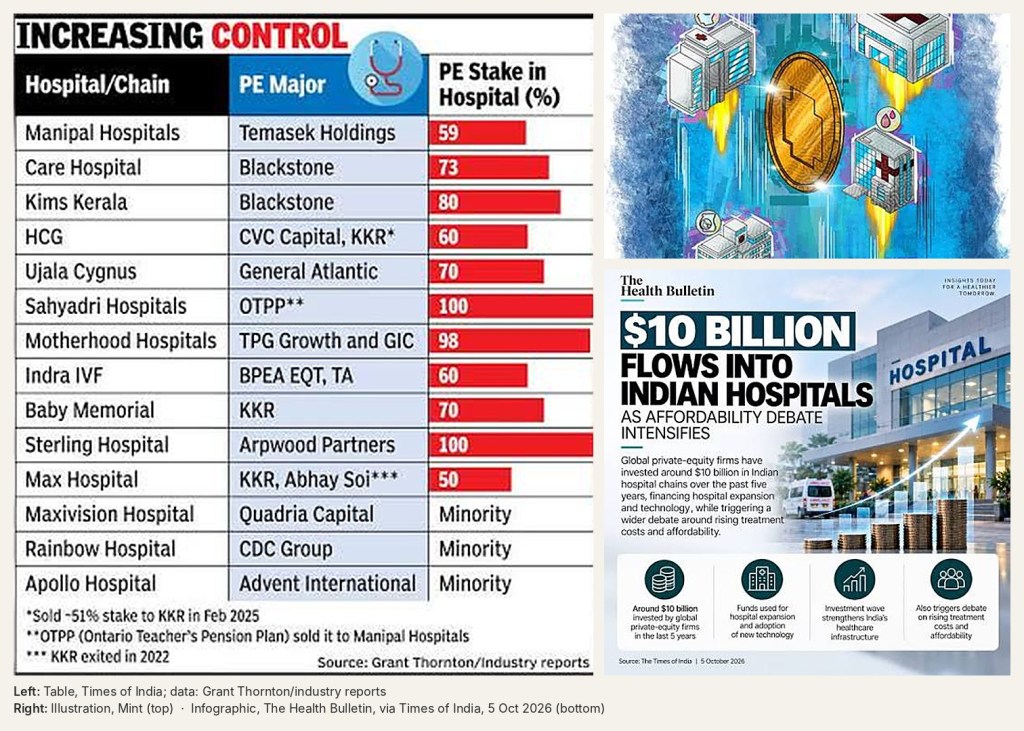
How did it become okay to talk about hospitals as businesses? How is that the patient has disappeared in these conversations, as we naturalize the focus on revenues per occupied bed, quarterly returns, and ‘case mix’ or ‘payor mix.’
A team of us have been studying financialization of healthcare for some years now. In one of the recent papers from this effort, just out in the Journal of Business Ethics, “Creating Infrastructures of Harm: Mythmaking and the Financialization of Hospitals,” Priyanshu Gupta and I examine the financialization of India’s hospitals.
This post is the first in a series that is based on our research and dialogues with other journalists, authors, and civil society organizations who are examining financialization. Here are three things I would like to share with you – something like a primer on financialization.
What is financialization?
How is it different from privatization that has been a key feature of Indian healthcare for decades?
Financialization is the growing dominance of financial markets, motives, institutions, narratives and elites in society, including over the State1. It overlaps with privatization and corporatization but must be understood as a distinct process. Privatization boils down to ownership. For example, who owns a hospital – is it public or a doctor-run clinic or nursing home, etc. Corporatization reflects large chains consolidating to gain market power. Financialization turns hospitals, whether public, private or corporate, into assets that can be bought, sold and traded for returns. Here, what matters is short-term profit for investors, not the provision of care.
Who are these financial actors? Think private equity (e.g., KKR, Blackstone), pension funds (e.g., Ontario Pension Funds), sovereign wealth funds (e.g, Temasek), venture capital (e.g., HealthQuad, Alkemi Growth) or asset managers (e.g, BlackRock, Vanguard)2. The folks whom Carsie Blanton sings about in Rich People?
But financialization is not just about a power bloc of financiers. It is a process situated in the circuits of capital – a particular form of circulation anchored around the credit system, entangled with circuits of production, reproduction, and exchange3. It functions at the macro-level, as a regime of accumulation, shaping policy. It shapes firm governance, impacting changes in corporate governance and organizational practices. And finally, it shapes work and social relations – our employment contracts, debt, our subjectivities, hopes, aspirations and dreams4.
Is it a new thing? Why are we talking about it right now?
Certainly, financialization is a term that has gained more attention recently in healthcare conversations more recently.
However, financialization as a process is older (e.g., see here), and gained academic attention and scrutiny particularly after the 2008 recession. Remember Occupy Wall Street! Critiques of financialization have grown since then – particularly around workplaces, climate solutions, transport, housing and the education sector (see Brett Christophers here and Grace Blakely here).
However, healthcare has been largely off the radar, and for reasons largely related to Global North practices. In Western Europe and Canada, countries did build forms of healthcare with a substantial public component, including care that is free at the point of use. So healthcare financialization in the Global North has looked different from India’s: it has entered more quietly, through the back door of public systems rather than in place of them. Elsewhere, governments facing pressure to cut public debt have turned to private finance through bonds, subsidies and regulatory changes. For example, France created an agency to repackage healthcare-related social security debt into products that can be traded on financial markets, and the spread of private insurance has pushed up prices for eye, dental and hearing care. In the UK, the NHS has seen steady cuts in public funding alongside the rise of New Public Management: private-sector managers, individual targets, and an internal “quasi-market” that has driven up administrative costs5.
The United States is the exception as a frontrunner since the 1970s. Private equity firms there have made over 8,000 healthcare deals worth an estimated $1 trillion in a single decade. In a systematic review in the BMJ, Borsa and colleagues found that private equity ownership of healthcare is linked to higher costs for patients and payers, with mixed to harmful effects on quality6.
In India, healthcare has arguably remained fragmented, split between a thin public system and a sprawling private sector. After independence, the state committed to public health through public hospitals and charitable institutions7. Universal provision was never achieved, but public programmes made real gains. The Universal Immunization Programme, launched in 1985, alone accounts for about a fifth of the fall in infant and under-five mortality in its first five years (Kumar, 2009), and life expectancy rose. In 1991, India adopted the International Monetary Fund’s structural adjustment programme. This drove rapid privatization and the corporatization of hospitals, and opened the door to international investors and private insurance5. Today private hospitals make up about 62% of hospital infrastructure8. Government health spending was just 1.43% of GDP in 2022–23, well below the National Health Policy’s own target of 2.5%9. Households still pay for about half of all current health spending out of their own pockets, and private hospitals absorb nearly twice as much of that spending as government hospitals do9.
Why should you care?
The language of financialization appears complicated, perhaps even intended to confuse. To begin with, you find an alphabet soup of acronyms.
Asset-Backed Security (ABS), Bank for International Settlements (BIS), Collateralized Debt Obligation (CDOs), Collateralized Loan Obligation (CLOs), Credit Default Swaps (CDS), Earnings Before Interest, Taxes, Depreciation and Amortization (EBITDA), Internal Rate of Return (IRR), Leveraged Buyout (LBO), Mortgage-Backed Security (MBS), Non-Performing Asset (NPA), Private Equity (PE), Real Estate Investment Trust (REIT), Special Purpose Vehicle (SPV), Weighted Average Cost of Capital (WACC)
So should we care?
First, financialization directly affects you. If you have wondered why hospital bills keep rising, why there is violence in hospital settings, why you doubt the tests and procedures you’re prescribed, or why public hospitals are left to crumble, yet are always over-crowded, these are connected – you may wish to understand financialization some more. Financialization is not merely about elite corporate hospitals in urban cities, but makes inroads into different dimensions of healthcare – medical devices, pharmaceuticals, insurance – and shapes public policy.
Second, financialization takes away accountability to the people. A small group of financiers, development finance institutions, technocrats, and consultants appear to hold more sway over decisions that shape a democracy than the people whose health and lives are impacted.
Third, financialization further subordinates the Global South to the Global North. Consider Singapore’s sovereign wealth fund or Canadian and German pension funds that now invest in Indian hospitals. The Ontario Teachers’ Pension Plan has owned the whole of Pune’s Sahyadri Hospitals! A nurse in Canada remains a rights-bearing citizen whose retirement is protected by those investments. A nurse in India, working on a precarious contract in a hospital owned by that capital, bears their costs.
In an age of widening inequality, health-related impoverishment and climate crises, we cannot afford to be governed by the fantasies of financial elites. Look out for the rest of this series. Meanwhile, here are some readings if you would like to read more:
- Devi Vijay & Priyanshu Gupta (2026). Creating Infrastructures of Harm: Mythmaking and the Financialization of Hospitals. Journal of Business Ethics, 1-20. https://doi.org/10.1007/s10551-026-06396-4.
- Marathe, S., & Shukla, A. (2024). Perverse development-examining German Development Finance Institutions’ engagement in private healthcare sector in India. Development. https://doi.org/10.1057/s41301-024-00408-4
- Arun Gadre & Abhay Shukla (2016). Dissenting Diagnosis
- Abantika Ghosh, Games Hospitals Play
- Ameer Shahul, Silent Syndicate
If this post resonates with you, do subscribe to the Sabr newsletter. You can also find our monthly conversations on care and health systems on Spotify and YouTube.
Until then:
- Blakeley, G. (2019). Stolen: How to save the world from financialisation. Repeater.
Christophers, B. (2024). Our lives in their portfolios: Why asset managers own the world. Verso Books.
Bruch, J. D., Roy, V., & Grogan, C. M. (2024). The financialization of health in the United States. The New England Journal of Medicine, 390(2), 178–182. https://doi.org/10.1056/NEJMms2308188
↩︎ - The examples named here operate in India ↩︎
- Bernards, Nick (2024). Fictions of financialization: rethinking speculation, exploitation and twenty-first-century capitalism. Pluto Books. ↩︎
- Van der Zwan, N. (2014). Making sense of financialization. Socio-economic review, 12(1), 99-129. ↩︎
- Vijay, D., & Gupta, P. (2026). Creating Infrastructures of Harm: Mythmaking and the Financialization of Hospitals. Journal of Business Ethics, 1-20. https://doi.org/10.1007/s10551-026-06396-4. ↩︎
- Borsa, A., Bejarano, G., Ellen, M., & Bruch, J. D. (2023). Evaluating trends in private equity ownership and impacts on health outcomes, costs, and quality: systematic review. Bmj, 382. ↩︎
- Gangolli, L. V., Duggal, R., & Shukla, A. (2005). Review of Healthcare in India. Centre for Enquiry into Health and Allied Themes. ↩︎
- Jaffrelot, C., & Jumle, V. (2020). Private healthcare in India: Boons and banes. Institut Montaigne. https://www.institutmontaigne.org/en/expressions/private-healthcare-india-boons-and-banes Accessed 29 June 2026. ↩︎
- Ministry of Health and Family Welfare. (2026). National Health Accounts Estimates for India 2022–23. National Health Systems Resource Centre. https://nhsrcindia.org/sites/default/files/2026-05/NHA%202022-23%20Report.pdf. ↩︎



Leave a Reply