

I take care of the elderly men and women. I wash their clothes, give them food, water, etc. I bathe them. Whoever is very sick. The ones who cannot get out of bed, whose hands and feet have given up. I help them…. When they defecate, I clean it up..… There was another male resident (bedridden). I used to place 2-3 buckets for him. One for urine, one for stool, and then I used to go to clean it in the morning. I sometimes cannot eat food because of the stench of the dirt. Now, I have just returned (to her residence) after throwing her waste. I will first take a bath and then make food… I haven’t been getting paid. Bada Babu isn’t giving even one rupee… They keep saying, ‘We aren’t getting the money now.’
Sneha– Caregiver at the old-age home
Sharada resides in an NGO managed state old-age home in a north-eastern town in Jharkhand. After a tragic fall that severely impacted her mobility, she lies listless on the bed for most parts of the day. “I am just praying for my death”, she says every single time I visit her. She worked as a domestic help in multiple households before moving to the old-age home. “I have no one. I washed the dishes and did the cooking, sweeping, and mopping. I used to work in several households. At least 3-4 households…. All of them know me, but nobody comes to see me,” she says with despair. A tremor seized her feet as she tried to move them even a little. “Moving it a bit every now and then helps with the pain,” she says. Gripping the edge of the bed, she lifted her feet off the ground in a slow, laboured movement, repeating maa in an agonising chant. She says:
Earlier, I used to do a lot of work (in the old age home). That is when I fell down. Now I get taunted for the same thing: ‘You used to be so keen to work, since 4 A.M. Now who is there to check on you?’…. My legs have given up…. Nothing can happen over here. Life is very difficult. I have become lachaar (helpless). I don’t know when God will give me a place beside him. Now I do not have the strength. Where will I go? My whole body, from my head to my toes, hurts. I cannot sit for long, such is my state. I keep sitting and lying down. I try to sleep, but I just cannot… I cannot get much sleep. I keep lying like this. I take the support of my bed to get up and lie down.…. Those who have money and have sick in-laws will spend money on their care….Where will I go? I will die here. Where will I go [voice stretching into a weary despair]? I will die here.
A plastic waste bucket beneath Sharada’s bed serves as a makeshift toilet, covered only by a tattered spice bag. When I first met her, she was frail, talking in mere whispers, and unclothed below her waist. She immediately covered herself with an old saree on seeing me. Later, as I began to leave, she raised both her hands in a gesture of blessing. She asked me to cover her with her saree as she lay down to rest and close the door on my way out. Behind that closed door, where residents rarely peek, Sneha is Sharada’s only companion. She has been taking care of her for the past several months. She sees it as a reciprocal relationship, “I treat her like my grandmother. She also treats me like her own.” She invokes her religious beliefs of paap (karmic consequence of sinful actions- dush-karma), punya (karmic consequence of engaging in good deeds or sat-karma) to explain why she continued working at the care home despite not receiving any salary for the past many months. She argued that if she left the old people on their own, it would be sinful. “If I leave them, the older men and women will die. They will die in their dirt. I won’t take that paap. They don’t have family to take care of them,” she shared.

“She used to chat a lot and liked being in the kitchen, cooking and making tea,” notes Sarla, and other residents of the facility. Now, Sharada can barely move to clothe herself and is entirely dependent on Sneha for daily tasks such as bathing, eating, grooming and toileting. “Nobody goes into her room. It smells really bad,” says Rekha, a resident at the old age home. “Here, they aren’t given any diapers. Nothing! Somehow, she manages it on her bed. Buckets have been given. She defecates in the bucket. A person comes and cleans it in the morning. But it cannot be that one would pass stool only once in the day. It can happen anytime. She is old. It can happen. She will just keep lying like that all day long. It will be cleaned the next day…. Nobody goes towards her room. If she needs something and keeps calling out, then people cover their faces with a cloth and talk from outside…Generally, nobody wants to go,” says nurse Nitya. “The Mehtarain comes and cleans the waste in the buckets,” says Sarla. She introduced everyone else by their names, except for Sneha and her in-laws, who were introduced as ‘Mehtars’. Mehtars are a historically stigmatized scheduled caste community whose members have been forced to perform the task of cleaning, sweeping, and scavenging. Most of the janitorial labor in care facilities is done by oppressed caste communities, who are routinely subject to hazardous working conditions, caste-based devaluation and indignation at work. Services of hygiene and personal care to the aged, all stigmatized as ‘dirty work’, have been traditionally undervalued and poorly paid.
As we undergo a massive demographic transition, often referred to as the Silver Tsunami in media reports, we pause to reflect on the state of elder care facilities in India. UNFPA projections suggest that India’s ageing population (aged 60+) will double by 2036, constituting 20 per cent of the population by 2050, with elderly women significantly outnumbering men.
In line with these projections are also estimates of the size of the ‘elder care market’ and the market logic of the neoliberal regime around which care is organized and recast as a marketable commodity. Driven by a shift towards assisted senior living, specialized care, reduced financial dependencies on families – coupled with a rising strain on family caregivers– investors discuss the potential of eldercare as the next big entrepreneurial opportunity, evaluating possibilities for expansion in areas of health and nutrition, support in forms of concierge managers, recreational facilities, day care centres, senior tourism, clinical and non-clinical home-based care, and in real estate that combines independent and assisted living in affluent senior care facilities and community villas.
A majority of elderly care facilities in India are for-profit ventures. Organization of care around the market logics have a tendency to underemphasize the crucial relational aspects of caregiving, due to its inherent focus on service standardization. This exposes the contradiction and fundamental incompatibilities between values associated with social care practices and the market ethos of cost efficiency and profit creation around which care is organized in private senior facilities. Moreover, these facilities can be afforded only by a handful. So, what happens to the vast population of the elderly poor for whom private care is out of reach? What happens to people who do not have medical insurance, financial security, a home, or a family to care for them? What happens to older individuals living outside conventional family structures?
A significant majority (more than 40 per cent) of India’s ageing population are low-income group individuals residing in rural regions, with nearly 75 per cent of them suffering from at least one chronic disease, and roughly 70 per cent of them need assistance with day-to-day living (LASI– Longitudinal Ageing Study in India). Against this backdrop, proliferating privatised care facilities such as Vedanta Senior Living, Covai Care, and Antara Senior Living are luxuries that are inaccessible and unaffordable to the majority of the ageing population. These dominant ways of imagining and organizing end-of-life care not just create exclusions, but also epistemic blindness, by making other alternatives seem almost inconceivable.
Due to inadequate geriatric care in rural areas and limited access to formal nursing or home-based care, the burden of care invariably falls on the family, which remains the primary institution for elder care in India. In the private sphere, a bulk of caregiving work falls disproportionately on women. Besides caregiving by the family unit, there is immense reliance on care and companionship provided by nurses, ayahs, and care-domestic workers, who offer a range of medical and non-medical support. Other typical arrangements outside the home include care homes run by non-profits, paid nursing homes, state and charitable old-age homes that provide residential and basic medical care, and private residential care homes with or without nursing support.

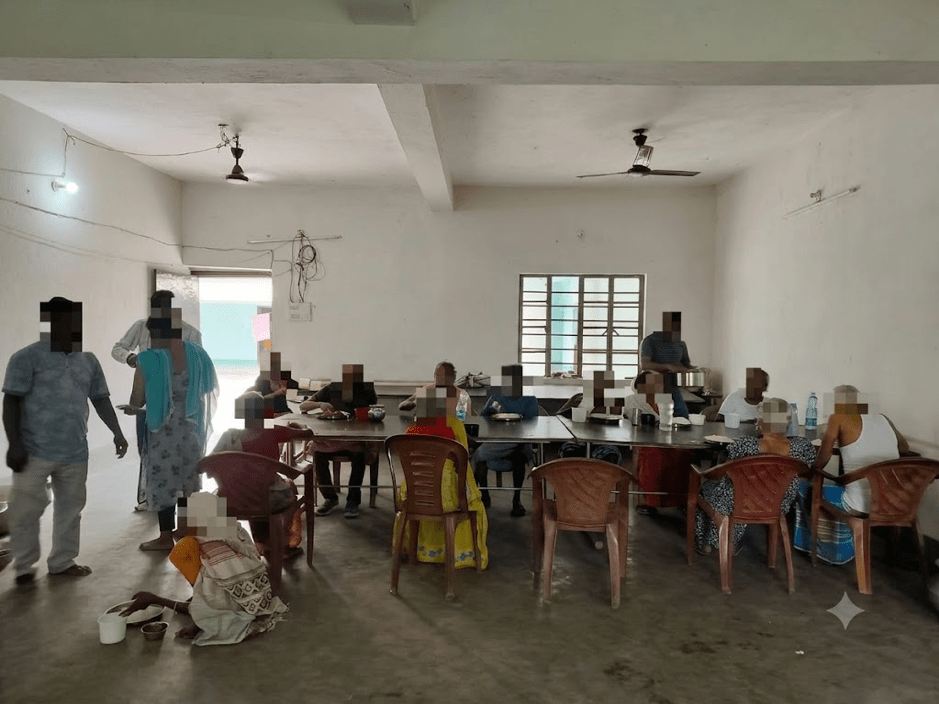
[To ensure participant confidentiality, the faces and unique geographical markers have been de-identified or blurred digitally]
The nationalist and state rhetorics have a tendency to paint India as having a uniquely linear and filial culture driven by values of collective respect. This myth of a standard life trajectory with heterosexual marriages being the norm and children taking care of their parents as they age allows the state to depoliticize care by treating it as a private concern of the family, as opposed to a matter of civic discourse and dialogue. This divide between the public and private spheres is used as a moral boundary that is weaponized by the neo-liberal state to relegate care to the margins of political discourse. The institution of family in India has historically had rigid patriarchal structures and has been a site for deep structural violence, subjugation of women, caste reinforcement, elder abuse, and gendered exploitation. The traditional family unit hasn’t been a safe haven for many, especially widows, queer and childless individuals. The systemic concealment of these conflicts and violence under the idealized facade of a collective culture allows the state to avoid building public welfare infrastructure for the elderly individuals, keeping them trapped within the family, even though it might be abusive. Portraying violence within the family unit as a moral failure instead of viewing it as a structural reality excuses the state from building infrastructures of care and further alienates the elderly vulnerable.
What happens when, as a society, we abdicate the responsibility for collective care? What happens when the state uses the perceived values of intergenerational responsibility as a shield to avoid investing in crucial public care infrastructure? What happens to individuals who fall through the cracks of the heteronormative family structures? Do elderly individuals age and die with dignity?
For this month’s Sabr piece, we bring you narratives of residents’ experiences of care, along with those of employees engaged in caregiving at a state-aided old-age home in Jharkhand. We ensured anonymity for all our interviewees. Therefore, we use pseudonyms for all the people we spoke with (the superintendent, staff members, visitors, and the residents). Sharada, whom we meet at the beginning of this essay, lives in the same NGO-managed state old-age home. A majority of state old age homes in India are meant for indigent elderly citizens, and their management is outsourced to non-profits. NGOs, therefore, are the primary intermediaries in the provision of state welfare benefits to elderly destitutes. They can list themselves on the government’s NGO Darpan portal of NITI Aayog to avail funding under the National Action Plan for Senior Citizens (NAPSrC, previously known as the Integrated Programme for Senior Citizens). The government sets out detailed guidelines and minimum standards for infrastructure and care provisions in such shelter homes. The Ministry of Social Justice and Empowerment, the nodal ministry for the care and welfare of senior citizens, ensures its implementation through the Department of Social Welfare.
We see how residents and caregivers in these facilities are subject to infrastructural volatility, which makes them vulnerable to uncertainties arising from poor disclosure practices by the NGOs, incessant delays in the allotment of funds, and misappropriation of funds. This is exacerbated by inadequate monitoring of service quality in care homes. Delegation of state responsibility without adherence to due monitoring mechanisms creates opportunities for corruption, maltreatment and abuse.
Even after years of debate and policymaking, elder care homes have woefully insufficient infrastructure to meet the long-term needs of the elderly. Crucially, these accounts expose that the problem is not limited to the rhetoric of the inadequate physical infrastructures, but is reflective of the broader systems of thought, structural violence and institutionalized ageism that produce these organizational realities.
This post is the first in our series of essays on elder care. To read more, click here.
By Shaima & Shalini
Resources:
Panchadhyayi, S. (2020). The Gender Question in Geriatric Care: Gender, Ageing and Caring Networks. Bhowmick, Amit/Wahab Olukorede, Elias (2020): Women in Changing World. New Delhi: Mittal Publications, 475-489.
Panchadhyayi, S.(2024). Ayahs: from the Colonial to the Contemporary. https://sabr.org.in/2024/09/30/ayahs-from-the-colonial-to-the-contemporary/
Panchadhyayi, S. (2025). Ayahs at the deathbed re-visioning elder care: bereavement support and anchorage for in-home dying older adults in urban India. Mortality, 30(2), 412-428.
Vijay, D. (2025). Plural imaginaries: reflections on end of life care from India. In Research Handbook on End of Life Care and Society (pp. 113-128). Edward Elgar Publishing.



Leave a comment