
Plummeting birth rates, increased longevity, and rising chronic illness are rapidly reshaping India’s demographic landscape. Furthermore, shifting family arrangements – driven by increased migration and nuclearization– force a departure from the idealized reliance on kinship networks. This challenges the long-standing nationalist moral myth of the ‘good old joint family’ as the sole site for elder care, thus underscoring an urgent need for a holistic elder care infrastructure. This demographic transition is more pronounced in the southern states of Kerala and Tamil Nadu, where rapid ageing, coupled with a highly migratory population, exposes the limits of familial care, thereby creating a need for institutional elder care. Elder care in India combines privatized care, old age assistance services provided by the state, charitable care homes, and community organizations for palliative care. A significant majority (84 per cent) of home-based care for the elderly is extended by invisible informal care providers like ayahs (caregivers for at-home elderly individuals) and domestic care-workers, who work at abysmal pay and often alongside other household chores.
Old age homes are important social settings for understanding the social construction of care and the biopolitics of ageing. For this month’s Sabr piece, we bring you narratives of residents’ experiences of care, along with those of employees engaged in caregiving at a state-aided old-age home in Jharkhand. We also reviewed government policy documents and guidelines governing the operation of elder care facilities. This is the second in our series of essays on elder care. In our previous essay, we shared Sharada’s story– a bedridden resident left partially immobilized after a tragic fall, and now entirely dependent on the underpaid labor of caregivers like Sneha. In this essay, we observe how the institutional decay within the care facility extends far beyond the containment of residents’ bodily suffering.
Elderly residents in this facility shared their experiences of entering and living in their final homes. These texts and narratives are crucial in not just understanding the organizational realities of elder care homes but also the discourses that produce them. We ensured anonymity for all our interviewees. Therefore, we use pseudonyms for all the people we spoke with – including the superintendent, staff members, visitors, and the residents.
The old age home, locally referred to as the vridha ashram (used interchangeably in our essay), sits far from the bustling markets and the mundane routines of the town, cloaked by a canopy of neem, kaner, mulberry, and mango trees. “All the trees that you see around have been planted by me,” mentions Sudesh unfailingly and with immense pride, in every other conversation we have. At 78, after spending most of his life working in the state’s forest department, Sudesh also worked as a guard and a gardener in the old age home, in its initial years, and complains that he hasn’t received the promised sum for his labor.
The outer walls that envelop the building are canvassed with vibrant paintings. These murals serve as allegorical reminders of the popular discourses of isolation, suffering and abandonment that are synonymous with old age homes –images of an old woman looking outside the windows with teary eyes, and the elderly being abandoned on the streets by uncaring families. In stark contrast, the wall paintings on the inside evoke a sense of comfort, portraying the old-age home as a serene sanctuary and an idyllic space, where elders are assisted on walks through manicured lawns by friendly staff, and residents smile and relax in congenial homelike settings – drinking tea, reading newspapers, knitting, and doing yoga.
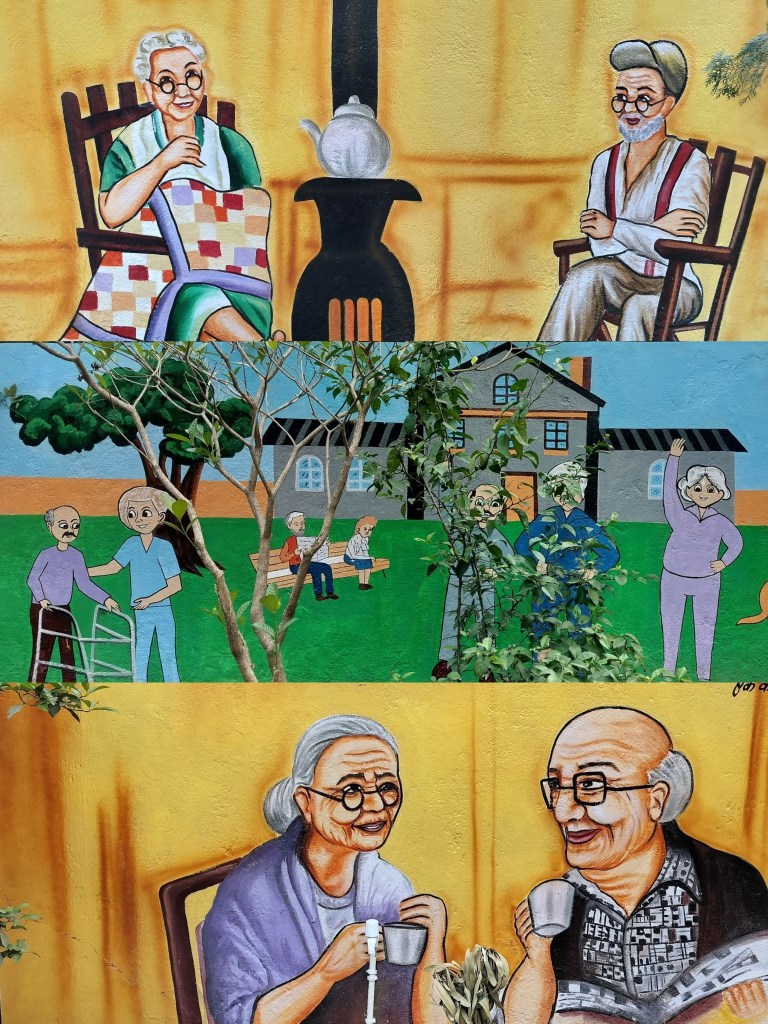
It took us just a few visits to realise that the pristine mural was worlds away from the residents’ lived realities. Behind the freshly painted walls lies an infrastructure of abandonment. This is one of the first state-aided care homes for the elderly in the district, which began operating 7-8 years ago and is run through the Department of Women, Child Development and Social Security. The responsibility for maintaining and operating this government establishment was handed over to an NGO. The contractor who managed this facility was known to everyone as ‘Bada Babu.’ Everyone had a long ledger of grievances with Bada Babu.
Among those residing in the ashram, many were elderly destitutes without any safety nets – no savings, no source of income, and no place to live. Some had to vacate their rented houses, and those who did have a home were either forced to leave or had no one to care for them. Their only source of income was the monthly 1000 rupees they availed from the state’s social security scheme for the economically vulnerable elderly population. Many arrived during the pandemic due to the loss of their livelihoods. Others had faced abuse at home or were abandoned by their families, some of them had been found living on the streets and were dropped off at the facility by locals or police officials, and a few others had outlived their children.
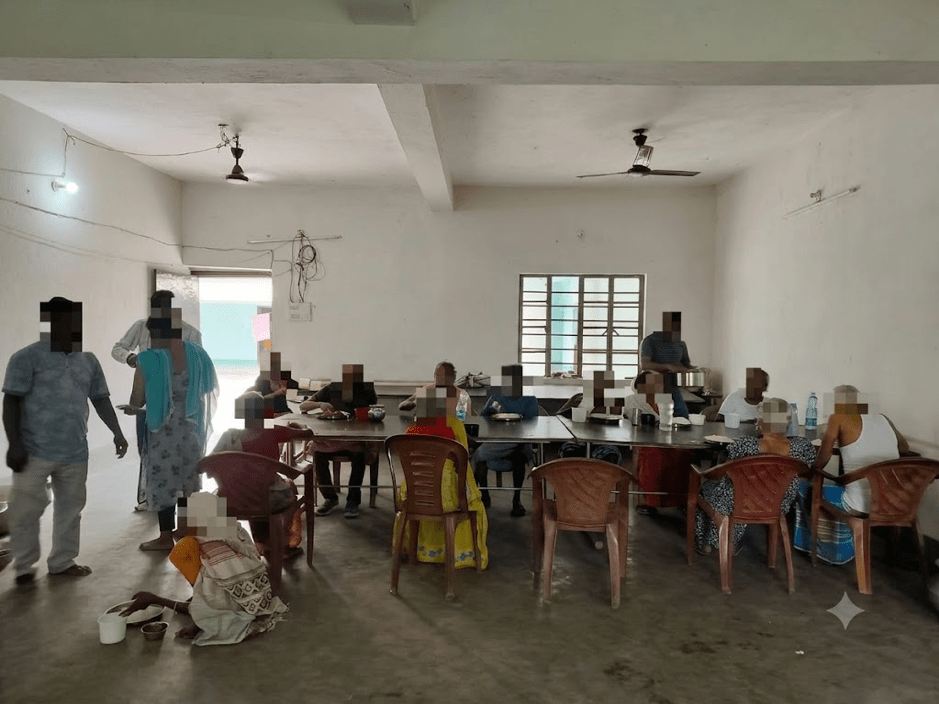
With the exception of a few residents who were relatively fit to move around, most others were frail elderly individuals grappling with reduced mobility, cognitive decline, visual impairment, chronic health conditions, and overall declining health. Some of them required increased care and assistance with their daily living. Though residents were responsible for cleaning their rooms, the common courtyard, utensils, and clothing, Sneha was hired to help those who found it difficult to manage these tasks on their own.
There were residents who were unable to recount their lives or share their personal histories or details. Mental health concerns like depression and dementia are increasingly common in old age, with at least one in three elderly individuals reporting having symptoms of depression. One elderly man in particular never interacted with anyone and spoke a language nobody understood. He had no identification details and spent his entire day sitting silently on a chair in the corner of his room. The only time he ever got up was to eat or to use the washroom. Another woman had been staying at the old-age home for less than a month after someone found her on the streets and dropped her at the facility. She sat on the verandah all day long, barely speaking with anyone, quietly singing folk songs. During one of my visits, I didn’t find her resting in her usual spot. The corridor was oddly quiet. I stepped outside to speak with Rekha, who was quietly smoking a bidi at her usual spot in the courtyard.
She laughed and responded, “Wo pagaliya? Wo jo geet gati thi? Wo toh bhaag gayi,[That mad woman. The one who sang folk songs. She ran away]” she laughed.
‘Where? She was here just a few days ago,’ I inquired.
“She ran away just the day before yesterday. She swept the entire garden from here to there, collected all the garbage, put it all in one place and burnt it. Then she stepped outside and vanished. Nobody even cared to look.” The superintendent, Aradhana, who oversees the care home’s operations, shared that none of the staff members had received any training or directives on handling cases of deteriorating mental health among the elderly.
Except for a few who travelled to make occasional visits to their relatives, most residents had little to no contact with the outside world. Aradhana shared:
Those who do not have children or family members are completely dependent on us. They will live and die in this place. The person residing next door is also unknown. He was found wandering somewhere. But he is extremely nice. He doesn’t interact with anyone. All he cares about is food. He mostly keeps sitting. He is completely dependent on us. Again, there is an unmarried man. His roommate, too, isn’t married, so there’s no question of children who can look after them. They are totally dependent on us. None of their families visits them. They stay here the entire time. Sometimes, maybe they step out to go to the market.
Those who did have distant relatives couldn’t afford to travel. “If I have money, only then can I go and meet them, right? I don’t have money,” says Mona. Sumri, an adivasi woman who was forced to leave her home after facing severe abuse and neglect, shared the same frustration:
I generally go there (to her parents’ home) during festivals. One needs to spend a lot of money on travel, hence I cannot go that often. Last, I went during the Sohrai festival. It requires a lot of money. So, who will go?….. They (the NGO) don’t give us any money for travel. Earlier, we used to get it, but now we do not. We have to pay for it out of our own pockets, and the fare has also increased lately.
The neglect is glaring when it comes to healthcare. The wait for medical care in the ashram is long and deeply frustrating. “I am supposed to get surgery for a hernia, but Bada Babu doesn’t give any money,” says Sudesh. Another resident with high blood pressure who has suffered from blackouts in the past mentioned that they do not get medicines for blood pressure on a regular basis.
Then there is Prakash. He survived leprosy years ago and decided never to marry because of his medical condition. When he ran out of savings and received no support from his extended family, he decided to move to the ashram, where he intends to spend the rest of his life. He shared that not all the ashram residents are aware of their illnesses or their severity, and that he is perhaps the only one who makes regular independent visits to the nearby government hospital. He added that they struggle to access basic, timely medical care. “Out of 12 months of medicine (for blood pressure), I have to arrange the medicines for one to two months by myself,” shared Prakash.
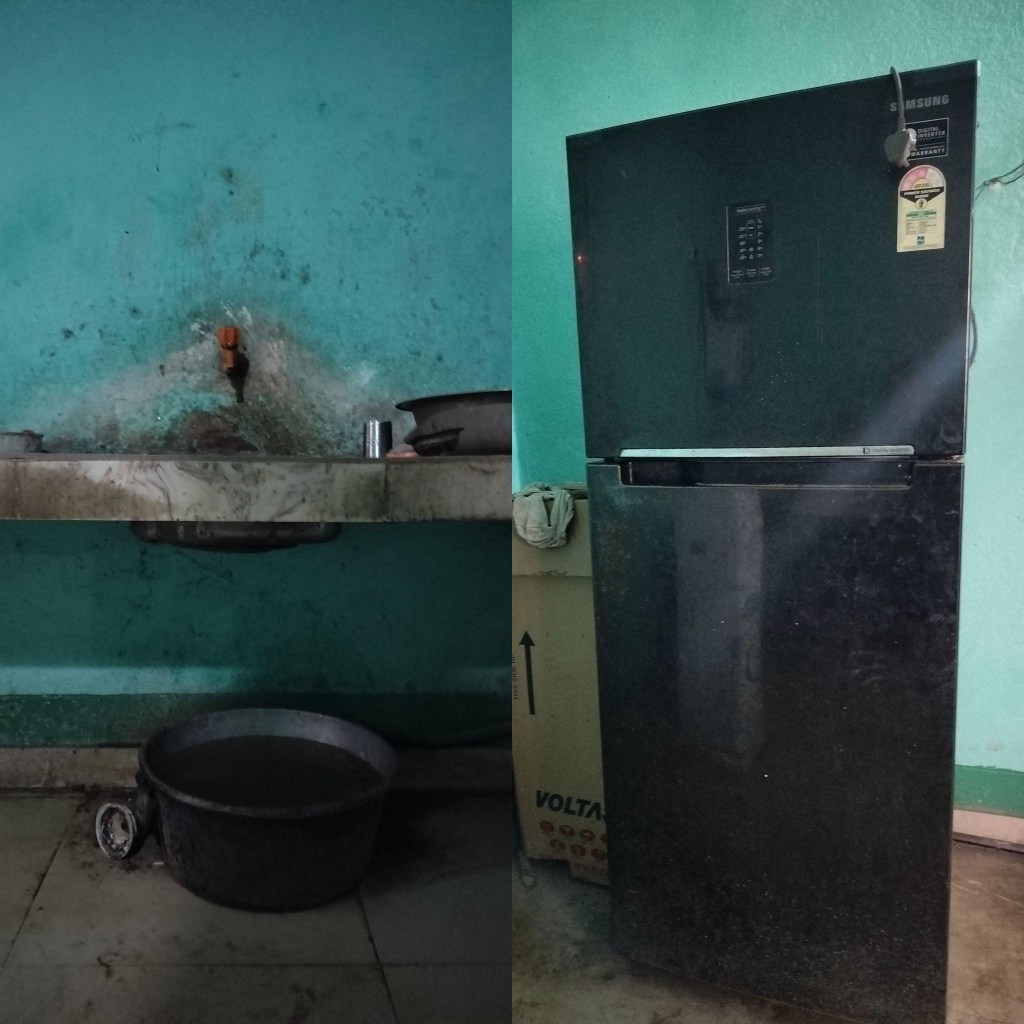
While the facility is supposed to be a welfare sanctuary and a safe haven for the destitutes, elderly residents shared that they are forced to finance their basic healthcare and comfort, and maintain the state’s crumbling infrastructure. “Today, after four months, we got the supplies! If it gets over, we buy it with our own money. When we go to ask, Bada Babu says, ‘I don’t have money’,” shared Sumri. Some residents also shared instances of open intimidation and recalled explicit threats that they would be asked to leave the facility if they tried to raise any complaints. Elders are expected to pay out of their thin pockets for travel, medications, diagnostic services (such as blood tests, X-rays, and ultrasounds), and even repairs and maintenance.
Even the superintendent noted these routine instances of negligence at the ashram. She shared that after getting tired of asking for help, residents Satish and Prakash pooled INR 150 to have their ceiling fan repaired:
Yesterday, two elders paid money and called the repair person themselves because their fan wasn’t working …. Bada Babu says, ‘Why should I pay? Your fan is not working. You see.’ They got tired of asking him. He didn’t send in anyone.
Recalling a winter when the water geyser broke, she added, “Once, the geyser wasn’t working. I contacted someone in the town and had it repaired. Half-winters, they bathed with cold water. This is not a complaint about this place. This is the reality.” Residents are made to wait for everyday essentials or are forced to get them independently. This routine negligence came to the fore in a conversation with Sumri, where our ad hoc interpreter, Sophia (name changed), helped us interview and translate Sumri’s story from Santhali:
Sophia: What happens when you ask for essentials when it’s over?
Sumri (Resident): I ask, ‘Give us soap or surf.’ Then he says, ‘Huh! Money hasn’t come. Where is your money? What do you do with the money that you get? Take soap and oil from that money,'[her voice stretching into a loud, angry imitation of his routine curt refusals.]
Inadequate medical support is a significant but partial aspect of the social suffering residents endure. They are heavily reliant on donations from civil society for basic equipment, repairs, maintenance, and even a good meal. A glass of milk, a bowl of curd, eggs or fish have never been part of their meals at the old age home. Sumri shared:
Sophia: How is the food here? What do you get for breakfast, lunch, etc.?
Sumri: How much will I eat? We get puffed rice. We get ghugni [black chickpea curry]
Sophia: How is the taste?
Sumri: [Silence. She shuts her eyes, her face tightening into an unpleasant expression, as she nods vigorously.]
Sophia: You get ghugni every day?
Sumri: Yes, we get that every single day for breakfast. In the afternoon, we get potatoes or some vegetables. Today, after many years, we got fish! [A family in the town had arranged a meal for the ashram residents]. That too, I got the head [laughs]. They gave us only the fish head! So, what can we do? [laughs loudly]. This is what is in our takdeer [destiny]. What can I say?
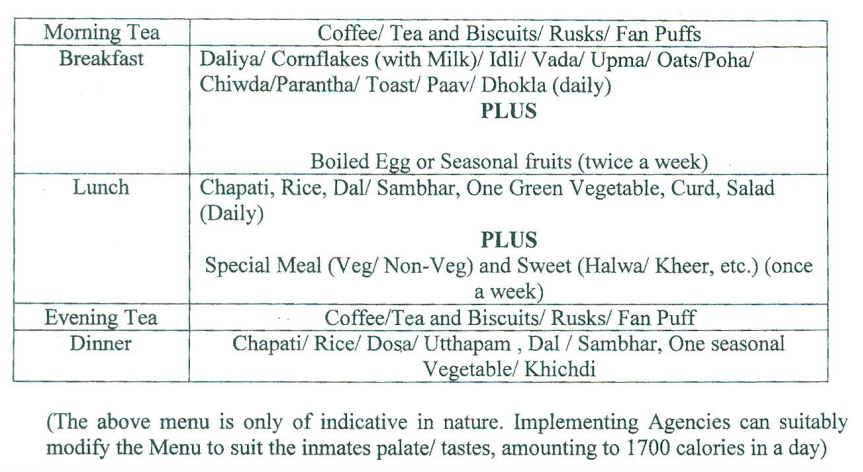
Residents are forced to live with bare-bones infrastructure, and care in the facility is reduced to mere biological survival. ‘Teen time ka khana mil jata hai bas’ [we get food three times a day, that’s it] was a phrase that was repeated ad nauseam. But merely addressing basic survival needs such as shelter, basic medical care, and three meals a day constitutes subsistence; it does not ensure a dignified life. Instead, it reduces senior citizens to their bare biological existence. Such processes of organizing care within the facility normalize a slow routine violence.
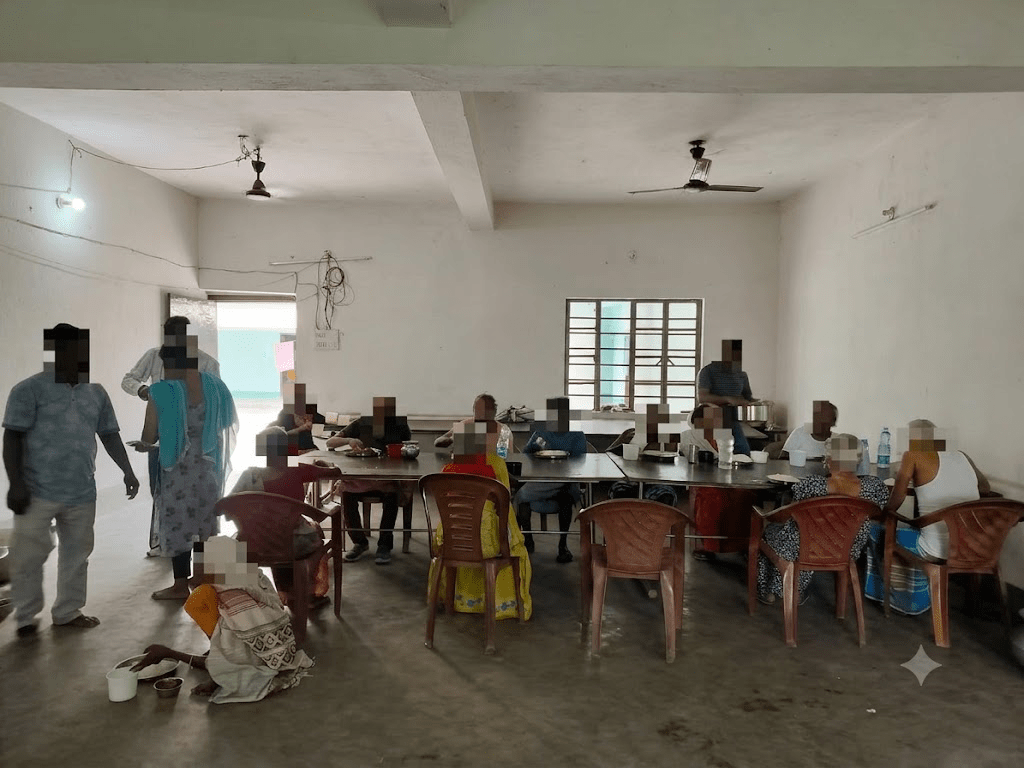
[To ensure participant confidentiality, the faces and unique geographical markers have been de-identified or blurred digitally]
In contrast to the imagined life on the painted walls, there was no peaceful knitting happening inside this old-age home; there was no man dressed in blue assisting people to walk in manicured lawns. The residents are expected to manage on their own. “If you are besahara (someone without any source of support), you become the support of someone else who is in the same situation. If there is any other resident who is capable of helping, they will help him,” shared Mohak, a retired professor and a frequent visitor to the ashram. There is no newspaper for them to read. Prakash has to fetch one from the tea stall adjacent to the ashram. Residents take care of each other as much as possible. There are tensions, fights and conflicts, but they coexist and are each other’s source of support in times of distress and sickness. They visit one another in hospitals, offer support to those in need, and remember and mourn those who have left.
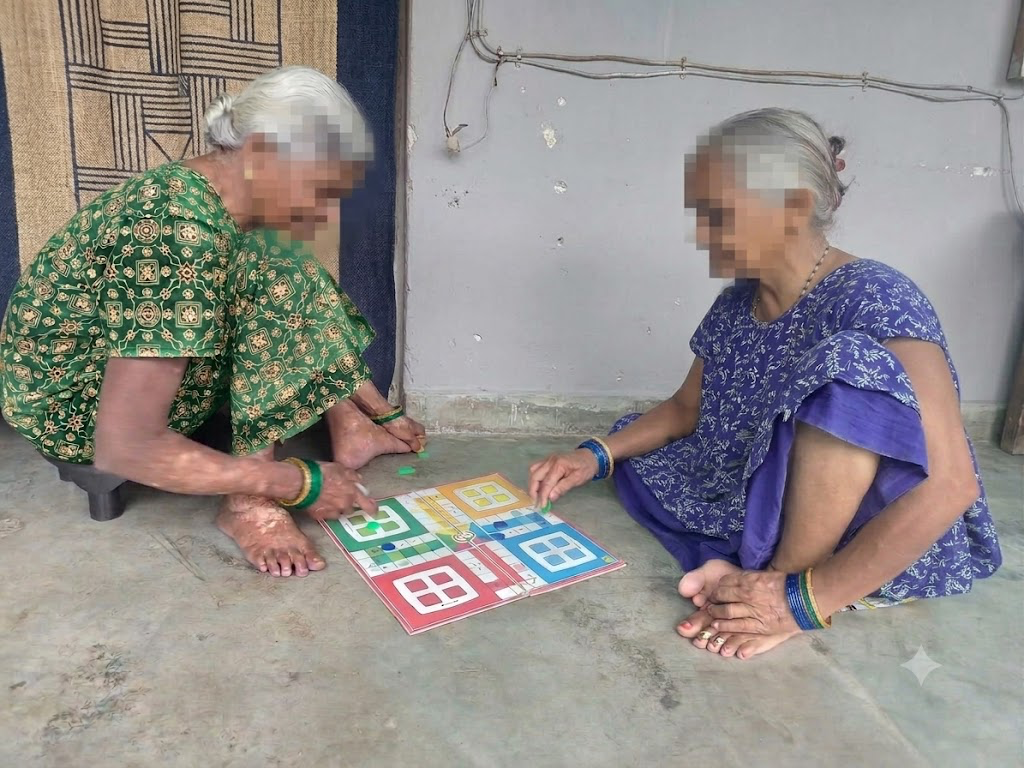
[To ensure participant confidentiality, the faces and unique geographical markers have been de-identified or blurred digitally]
For the state, ensuring that elderly destitutes can live with dignity is not a matter of choice or charity, but a fundamental constitutional obligation, under the Maintenance and Welfare of Parents and Senior Citizens Act, 2007. The Atal Vayo Abhday Yojna (AVYAY), formulated to implement sections 19 & 20 of this act, enlists detailed guidelines for the functioning of senior care homes and covers “all possible affirmative actions which can be taken for the welfare and well-being of the Senior Citizens in the county, enabling each one of them to live a life with dignity.” But what happens when this responsibility is outsourced to non-profits without adequate regulatory check-ins? A report by Tata Trusts notes that, despite such national policy measures, not only does India have woefully inadequate infrastructure for elder care, but there is also little done on the ground to monitor the functioning of the existing senior care facilities. This profound gap between the state mandate and the ground reality creates a peculiar institutional purgatory that leaves both ageing residents and caregivers trapped in spaces of spatial stagnation. There are provisions for legal aid (NALSA) for senior citizens and maintenance tribunals for their welfare, but without enabling social infrastructure, they remain frozen as mere paper rights.
There is much to learn from the stories and experiences of care providers and recipients, and how they practice sabr in building systems of care. Words feel inadequate to capture the weight of their experiences –the long silences we witnessed during our conversations and interviews, profound exhaustion resulting from bureaucratic delays, and a quiet angst against the ruthless hellhole of corruption– all pointing towards the many ways in which the state infrastructure has failed them. Yet parts of their descriptive accounts that remain invisibilized in mainstream conversations and dominant narratives of care can continue to exist in this digital space as a reminder of this failure. It could be more for our comfort than theirs. To some extent, writing eases the discomfort and dismay we feel in the face of our own silence, lending us the patience and hope necessary for any struggle. Perhaps it makes us less complicit. Why else would people document the state of crumbling infrastructures, pain, suffering, injustices, and the wreckage caused by radicalized violence? We do it because an archival void of the experiences of the marginalized is perhaps more violent than its erasure. Sabr, then, ceases to be a passive act. It becomes a political necessity and a crucial knowledge infrastructure for alternative world-making.
This essay is the second in our series of essays on elder care. Visit our site for the forthcoming pieces.
By Shaima and Shalini
Resources:
Brosius, C., & Mandoki, R. (2020). Caring for old age: Perspectives from South Asia. Heidelberg University Publishing.
Cohen, L. (1998). No aging in India: Alzheimer’s, the bad family, and other modern things. Univ of California Press.
Lamb, S. (2000). White saris and sweet mangoes: Aging, gender, and body in North India. Univ of California Press.
Panchadhyayi, S. (2025). Ayahs at the deathbed re-visioning elder care: bereavement support and anchorage for in-home dying older adults in urban India. Mortality, 30(2), 412-428.
Vijay, D., Monin, P., & Kulkarni, M. (2023). Strangers at the bedside: Solidarity-making to address institutionalized infrastructural inequalities. Organization Studies, 44(8), 1281-1308.
Vijay, D. (2025). Plural imaginaries: reflections on end of life care from India. In Research Handbook on End of Life Care and Society (pp. 113-128). Edward Elgar Publishing.

 Sabr: A care collaborative
Leave a comment