
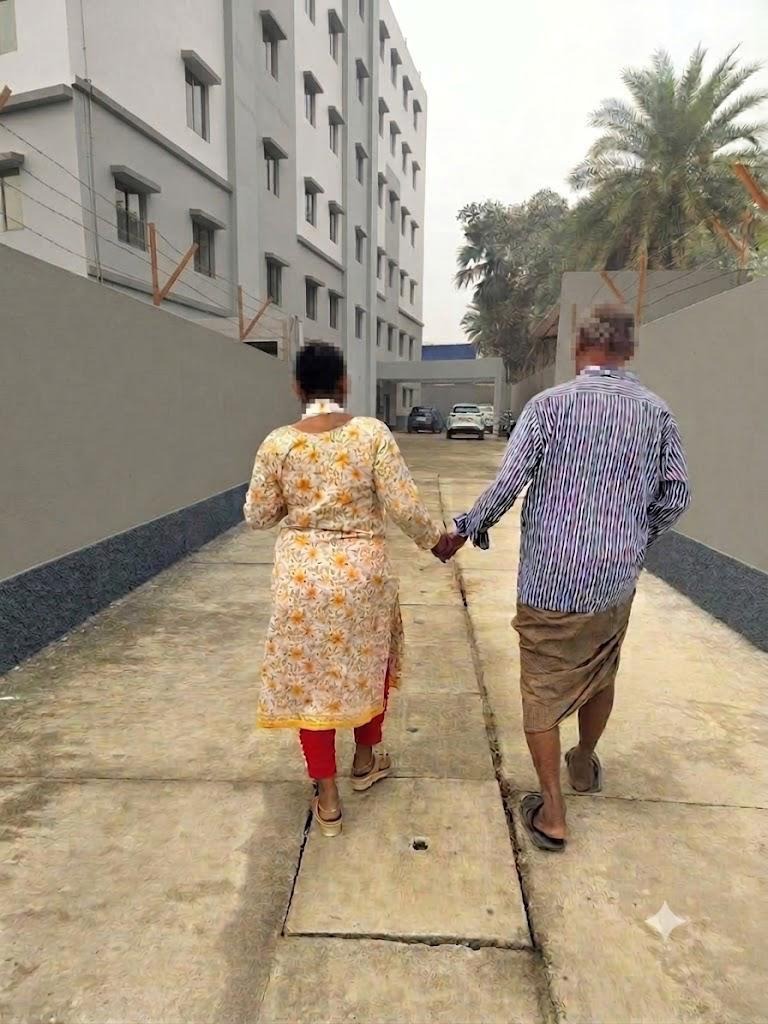
Whenever I take them somewhere. I don’t take them as a patient. They are my grandparents. She is my dadi (grandmother). I have to take care of her. You won’t believe it, the people there (hospital staff) have given me the name ‘Ashram.’ Everyone there knows me. They will see me coming and joke, ‘See, Ashram has come.’ I have taken them with me so many times. They joke, ‘Who knows whom she is going to leave here this time?’ I tell them, ‘I am leaving them here by placing my trust in you. If anything happens, I will ask you. I will call and disturb you people only,’ (laughs)… I am attached to people even there. I have to blend and get along with them as well to get the work done.
Nitya- Nurse at the old-age home
The people above should pay some attention to those working beneath them. But till today, whenever they have come here, they have only seen the security or the painting over here. They are looking at the painting on the wall. Twice, he (the administrative head) came here after joining, but he didn’t have time to listen to our stories. Our staff tried to tell him up front, but he doesn’t have time to listen to us. You came here, and you got the walls painted. Then again, 3 months before you got the painting done. Is that painting of any use? Is it feeding someone or helping someone run their house? [voice gets louder] It will turn white again in another 3 months. Did you listen to me even once? I went to you with my application so many times! Did you reflect on it even once?
Aradhana- Superintendent of the old-age home
Unpaid household work, care work and domestic work are stereotypically perceived as feminized work. Yet, care has hardly been exclusive to the domestic sphere. The gender and caste divides in care work run deep, fundamentally shaping the care economy where such labor is systematically undervalued and underpaid. But what happens when caregivers subject to conditions of inequality are forced to work in low-resource settings?
For this month’s Sabr reading, we bring you narratives of caregivers at a state-aided old-age home in Jharkhand. This is the third and final in our series of essays on elder care. Most caregivers in the old age home we visited were women from oppressed-caste communities. We found entanglements of different forms of social difference and the myriad ways in which gender and caste hierarchies are reproduced in sites of care work, keeping individuals trapped in webs of inequality and indignation. Chiefly, the staff members reported that the wait for salary in the ashram is long and infuriating.
Salary is a gamble
I haven’t been getting paid. Bada Babu isn’t giving even one rupee… They keep saying, ‘We aren’t getting the money now.’ ‘When the government sends money, then only I can send it, right?’ This is what they say… I do not feel like leaving this job, because if I leave, then they will die. I am doing the work, and that is why they have some support…What will I do, didi? If I leave them, the older men and women will die. They will die in their dirt. I won’t take that sin. They don’t have a family to take care of them.
Sneha- Caregiver at the old-age home
The old age home had six staff members: the kitchen staff, a cleaning staff who cleaned the toilets in the morning, an assistant who helped residents suffering from reduced mobility with their daily tasks, a nurse who visited the facility when residents needed to be accompanied to the hospital or required basic at home medical care, a staff member who delivered essentials and occasionally cleaned the premises, and the superintendent, who oversaw the care home’s operations on weekdays. Apart from the kitchen staff, who stayed in one of the rooms meant for the residents, none of the staff members stayed at the facility. All of them reported that the payroll was a gamble and that they were forced to wait months for their salaries to be disbursed. Many former employees had quit over unpaid wages, while all the long-term employees reported having roughly 2 to 4 years of their cumulative salaries pending. Consequently, some of them stopped visiting the ashram regularly and were forced to find alternative sources of income.
Aradhana, the superintendent who is now applying for other jobs, shared:
Now I don’t feel like working here. Initially, I used to come here with a lot of ullaas [joy]. It would be as late as 8 pm at night, and I still didn’t feel like going back home. Now I don’t feel like coming. Now I am absent for many days. I purposefully do it……I have given freedom to all the staff. None of them used to go anywhere before. But after seeing the condition here… it is so difficult for them to sustain their families. I tell them. Go! I will answer if somebody asks where the kitchen staff is or why they are late.
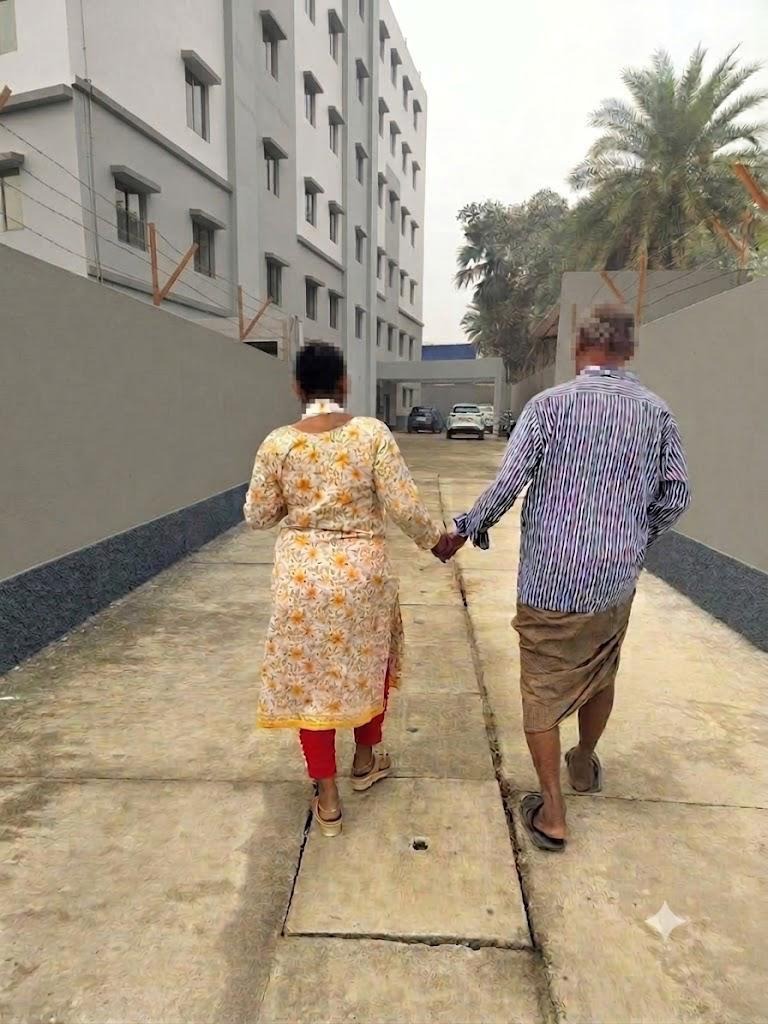
[To ensure participant confidentiality, the faces and unique geographical markers have been de-identified or blurred digitally]
Endless Care Crises
Caregivers in the ashram remain trapped in a cycle of endless crises stemming from bureaucratic delays, corruption, and the maintenance of crumbling infrastructure. Aradhana’s everyday struggles illustrate this breakdown, as she has to constantly scramble for funds to cover medications, repairs, facility maintenance, and even the most minimal travel fare for hospital visits. Additionally, her narratives pointed to a severe lack of institutional support, where none of the employees received any formal training to care for elderly residents who had been suffering from mental illnesses. She reported that even the facility’s registration form, which records details of new residents, was entirely designed by the staff members. They had no guidelines in place to verify the identities of residents who couldn’t recall their personal histories or identities. These glaring anecdotes reveal how caregivers in old-age homes remain grossly under-equipped. Ultimately, the facility has to rely on contributions from civil society and residents’ pension funds just to meet basic needs and keep running.
Aradhana elaborated:
They [residents] are using money from their vridha pension…. That vridha pension is given to you for your happiness. You eat whatever you desire from that 1000 rupees. Now, you shouldn’t be asked to live out of that money, but that is what is happening here. What can I do? I cannot kill the patient, right? What option do I have? Over the past 7 years, there have been numerous occasions when I have spent money out of my own pocket. I even made a note of it. I cannot be giving money from my home, right? I also told them, see, this is how much I had to spend out of my own pocket. I had given it in writing. That money is never returned to us. Then why should I put my money? If I had been getting money from here, I would have given it, but if I have to take money from my parents and spend it here, that would be extremely foolish. Why should I work?… I cannot fill the gaps here. I am not so capable, otherwise I wouldn’t be working here, right? Now, I don’t feel like working here. Just understand this thing that, in a way, they are cheating us by saying, ‘You will get (the payment) today, tomorrow, day after tomorrow.’ If I leave it to them, ‘that okay, you give it to us when you get the money,’ then there is no chance that we will ever get it. There is only one purpose of coming here, that my past dues haven’t been cleared. I can give it to you [referring to the caretaker] in writing that this is my pending salary. Whenever your money comes in, give it to me, and I am resigning today. You accept this. You won’t accept it! You will steal!
The mandarins – district administrative head, and welfare officers, who ask ‘sab thik hai [Is everything okay]?’ like a rote formula, on their occasional visits to the ashram, are more concerned about the aesthetics, shared Aradhana. “They saw the state of the paint on the wall but didn’t stop to think about the condition of the staff and the people who put their labour into running the facility,” says Aradhana.
The caregivers undergo an invisible exhaustion from tending to the residents and managing the conflicts that erupt every now and then. Nitya works at a private clinic because of the irregularities in pay. The kitchen staff, Sunita, is a single parent who lives in the ashram and has to fend for her family of three children. She single-handedly prepares three meals a day on a clay stove, picking up heavy utensils and cleaning the kitchen, with no support staff. A few resident women assist her with meal preparations and basic kitchen chores. Sunita also works as a domestic help at the nearby hospital quarters to sustain her livelihood. She notes how once she is back from work, she has no spirit or energy left to cook with patience or love. Residents complain about the food, but some also empathize with her situation. Who cares for the caregivers? Who listens to their needs and requirements?
The narratives of people in the old-age home underscored the central role of informal caregivers and civil society in managing the crisis of care. These stories emphasize the need to reimagine possibilities for end-of-life care for the growing elderly population in India. Despite state interventions and years of senior care advocacy and policies, why do elderly destitutes not receive dignified end-of-life care? Why are caregivers expected to keep showing up at work and extending their physical and emotional labor despite erratic and poor compensation?
Despite population projections, reports indicate that the existing elder care infrastructure –including geriatric health services– is grossly inadequate to provide sustained and dignified care to the growing elderly population. Reports indicate a significant need for palliative care among elderly individuals, particularly in West Bengal, Madhya Pradesh, Bihar, and Uttar Pradesh. With approximately two in every thousand people (a significant majority of them being elderly individuals aged over 60) needing access to community-based palliative care, there exists a profound gap between the number of available caregivers and the elderly population requiring care, especially in rural areas. This presses an urgent need to rethink the organization of long-term care for elderly individuals and proritize more publicly funded and well-equipped senior care homes and geriatric care facilities.
Moreover, the bulk of caregiving work for the elderly in the public sphere rests significantly on untrained and underpaid caregivers who are predominantly women. Rising financialization of staple infrastructures devours crucial public infrastructure and subjugates alternative realities of organizing care. Despite these visible fractures and harsh material realities, community-based elder care in India remains a distant dream. These systemic failures push us to confront an important question: are we ready to imagine worlds elder-wise?
By Shaima & Shalini
Resources:
Panchadhyayi, S. (2020). The Gender Question in Geriatric Care: Gender, Ageing and Caring Networks. Bhowmick, Amit/Wahab Olukorede, Elias (2020): Women in Changing World. New Delhi: Mittal Publications, 475-489.
Panchadhyayi, S. (2025). Ayahs at the deathbed re-visioning elder care: bereavement support and anchorage for in-home dying older adults in urban India. Mortality, 30(2), 412-428.
Vijay, D. (2025). Plural imaginaries: reflections on end of life care from India. In Research Handbook on End of Life Care and Society (pp. 113-128). Edward Elgar Publishing.




Leave a comment