
‘My mother and my sister-in-law were lying unconscious on the hospital floor. The doctor said, ‘Take your brother from here or he will die’ I felt so helpless. That moment will stay with me forever. For so long as I live. I will never forget.’ Deepak (36, name anonymised)
‘Not everyone can afford treatment in these private clinics, especially those residing in rural areas… Someone loses their kid, and someone’s mother will die… then people here remark that we do not have good doctors in our district. If only we could have taken them to that particular city or town, they could have survived. They then curse their destiny, and ask – What kind of a place am I living in?… Suppose there is a road accident here and someone suffers a head injury, then we do not have a single doctor here who can handle that case…If they somehow survive the travel, because it takes 3-4 hours for us to reach the other town, and manage to reach there, the doctors there demand a lot of money. People desperately want to save the patient and are willing to sell their land, property and assets to get them treated. Even after doing all of that, if the patient still dies, they cry over their destiny.’ (Chirag 30, name anonymised)
These testimonies serve as a critical remark on the fragmented state of the public health system that has undergone significant transformations under the state’s neoliberal measures and its consistent push to privatise health care. India has the lowest spending on health amongst the G20 nations, and universal and equitable healthcare in the country is still a distant dream. At present, India’s healthcare budget as a percentage of GDP stands below the global average. It was around 1.9 per cent in 2023-2024, against the National Health Policy’s (2017) target of at least 2.5 per cent. Out-of-pocket expenditure (OOPE) still frequently pushes families below the poverty line. [Even as there are reports of OOPE reducing to 47% from 64% of total healthcare spending, a recent Economic & Political Weekly article contests this claim on declining OOPE]. These testimonies are also a searing comment on the widening rural-urban divide in the country. Approximately 65% of India’s population resides in rural areas, yet only 25% of the country’s healthcare infrastructure serves these regions.
Our attempt to bring these accounts is to move beyond the statistics. As Mike Davis notes (2005: 3), “[i]n order, to grieve over a cataclysm, we must first personify it,”
Deepak is a potter and an idol-maker, residing in one of Jharkhand’s most backwards districts. Chirag, a resident of the same town, works at a small stationery store. Their district is wrecked with issues like broken roads, weak infrastructure, a dearth of employment opportunities, and access to critical medical care. Every year, many of his friends are forced to migrate to cities like Delhi, Mumbai, Bangalore, Surat and Kolkata in search of work. The state’s lack of sustained efforts in addressing regional imbalances and infrastructural inequalities exposes them to precarious work conditions in an alien place. They are incessantly on the move, to places that need them but do not want them. Indian towns and cities are no exception to the anti-migrant sentiments proliferating across the globe. The implications of these internal work-related migration sentiments are fairly evident in state policies for local reservations. They now get targeted based on their language, religion and have to prove their Indian citizenship.
Deepak’s hands glide over the delicate heap of freshly collected clay from the forgotten ghats of the Ganga. The wheel underneath revolves continuously, and with a seemingly effortless play of hands, he creates a very simple and beautiful kulhaad (earthen teacup). He sells these tiny kulhaads for 60 paise each, and the bigger ones fetch him a rupee.
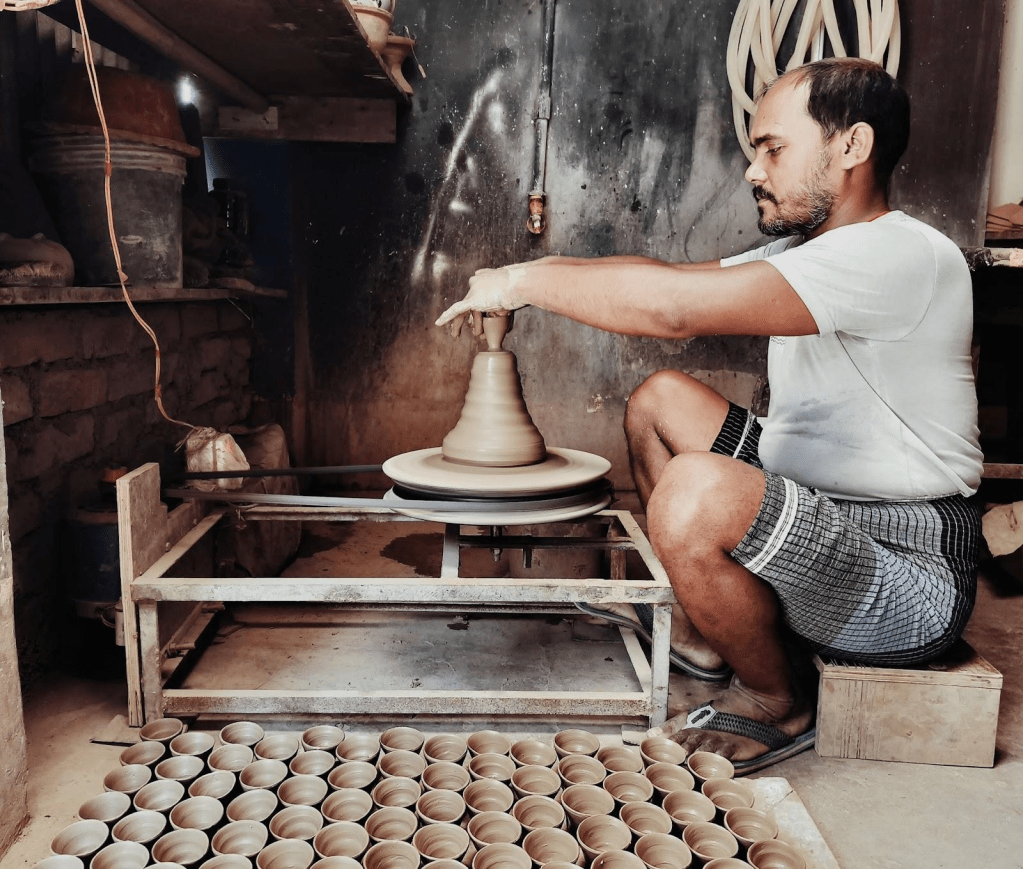
A significant portion of his earnings comes from idol-making during major festive seasons like the Durga Puja. In the off-season, Deepak and his father make kitchen utensils and other household items for sale to local customers and tea vendors. This meagre income is barely enough to sustain his family of nine, so he also runs an e-rickshaw, often at odd hours.
A few years ago, Deepak’s brother was diagnosed with renal failure. Because of the lack of critical health infrastructure in his region, Deepak had to seek treatment in neighbouring towns and cities. He shared that the public hospital there did not even have basic diagnostic facilities. ‘In this place, even for blood tests, the samples are sent outside, because there is no facility here. You have to wait for the test reports to come from outside for the treatment to start.’ shared Deepak. There was no facility for dialysis in his town at that time, forcing him to travel 70 km each time his brother had to undergo dialysis. He was distraught by his experience at the public hospital in his town the night his brother suddenly fell sick and passed away. ‘There is no ICU here. If something happens to the patient, you cannot admit them to the ICU. They have all the machines, but they do not have experts or doctors who could put them to use,’ sighs Chirag. From fractured limbs to renal failure, the medical care in their district is often compromised.
Chirag shared his struggles while seeking treatment for his father. According to Chirag, the doctors at the public hospital couldn’t even make a clear diagnosis and referred him to a public hospital in another town. He later sought treatment at a private clinic in Bihar. He had 4-5 consultations with the doctor there, who informed Chirag that his father was suffering from a heart ailment. “I spent around 10-15 thousand rupees per visit. I used to take an e-rickshaw to the station. I travelled with great difficulty. I tried to return to my hometown on the very same day. If I couldn’t leave on the same day, I used to spend the night at the hospital verandah,” shared Chirag.
He later admitted his father to a public hospital in another town, and the doctor advised him to keep an oxygen cylinder at home. “But I stay in this place. How could I get an oxygen cylinder in this place [emphasis added]? I had to stay there for one to two weeks,” remarks Chirag sarcastically. After he returned home, his father’s health suddenly deteriorated, and he had to admit him to the local hospital. He narrated:
The doctor here couldn’t understand anything, and my father died of a heart attack. He needed oxygen. The doctor was sitting right there, but he couldn’t put on an oxygen mask. Moments after he passed away, another patient came and told the doctor, ‘He had pain in his chest, and he fell on his face. He needs oxygen.’ Then the doctor rushed and immediately put him on oxygen support, and after 5-10 minutes of putting on the oxygen mask, he declared him dead. My father had passed away even before he had put on the mask. This is the state of the doctors in this town.
Such accounts are critical commentaries on the stark inequalities and the widening urban-rural divide in the country, where large sections of the population remain deprived of basic care facilities. At a time when even the poorest (typically without medical insurance) are becoming increasingly reliant on private hospitals for medical care, a significant majority of the population residing in remote areas find it difficult to access such treatment, further amplifying the cost and widening this divide.
Commenting on the pro-business model of private healthcare clinics in the town, both Deepak and Chirag shared how practices in these clinics seem completely devoid of compassion and the notion of social responsibility. ‘How does it matter to the doctor? They will write you several tests. They know that so many tests are not required. Still! Now, there are 3-4 machines in the hospital, so they also have to ensure that they keep running, right?’ says Deepak. Chirag questioned the prevalence of private practice by government doctors in his town. ‘Why do they run their private clinics?’ asks Chirag. ‘If they provide the same treatment here at public hospitals, then we can get the same facilities as private clinics in our public hospital.’
What makes these testimonies particularly numbing is their sadly typical occurrence, a near-routine misfortune that has become an endemic feature of rural India. Several intractable factors in rural India prevent many from availing timely and quality healthcare. These are stories many of us have heard of, and some of us, experienced firsthand. In today’s conjuncture, where journalism is reduced to spectacles, these accounts are unworthy of prime time slots, even as a mere observation or a neutral passing commentary. The number of avoidable deaths in the absence of critical medical facilities in rural India goes undocumented and unreported. Who will hear their testimonies, and whom will they address?
The jarring inadequacies of the public healthcare system, which the COVID-19 pandemic unravelled, pushed some of these concerns to the forefront of public discourse. But what have we learnt ever since? As members of medical communities, as citizens, human beings? How do we organize care?
By Shaima & Shalini
References:
Davis, Mike (2005). The Monster at Our Door: The Global Threat of Avian Flu, New York: Henry Holt and Company.





Leave a Reply