
“Why must identity be proven, and why to a specific authority?”
The Transgender Persons (Protection of Rights) Amendment, 2026, could be reflected upon as a criminalization process, rather than a positive addition to the charter of rights for transgender and gender non-conforming individuals. The 2019 Act with the same name, even though flawed, provided an opportunity for individuals to identify as transgender without making it mandatory for them to access hormonal or surgical procedures. It was in consonance with the 2014 landmark NALSA vs the Union of India judgment which upheld the right to self-identify gender. On 13th March, 2026 the Ministry of Social Justice and Empowerment of India introduced the Amendment as an attempt at clarifying the definition of who a transgender person in India truly is and who could claim the benefits of the Act. The bill was quickly passed in both the legislative houses and received the President’s assent on 30th of March, 2026. In doing so, they limited the definition of transgender persons to what is now defined by biological, hormonal and/or physical traits, confusingly equating intersexed individuals with them. At the same time, distorted and incomplete references are made to specific indigenous sub-cultures – Hijra, Jogti, Kinner and Aravani, as identities that could claim the transgender identity in India. No mention is made of the rights pertaining to nonbinary individuals and other gender nonconforming individuals who do not identify with the word “transgender”, or with any of these specific sub-cultural identities or are not willing to transition into any of the two binary genders that was not assigned to them at their birth.
At the same time, most of these sub-cultural claims to identity are limited to assigned male at birth individuals only. Thus, transgender men, individuals who were assigned female at birth are now at a precarious position. Undergoing hormone therapy and engaging in surgical procedures would now be the only way to claim a transgender identity, which again ought to be verified in front of a medical board and a government official to access any change made in one’s important identificatory documents like the Aadhar card or the transgender certificate.
Since its inception, the Amendment had garnered multiple criticisms, converging previously dissenting voices in the arena of queer-trans rights and the larger transgender movement in India. But what it also brought in was a sliver of hope in a canvas that was engrieved with despair. Every known queer friend and activist was not limited to talking about the Amendment between themselves in echo chambers. They formed groups on social media, disseminated information about the Act, prepared leaflets, campaigned for signatures and email drives to parliamentarians and the President and organised Press meets and meetings with political parties and leaders who were expected to lend an empathetic ear.
Tumultuous times often bring a paradigmatic shift in the way in which people think and organise. This situation was no different. People came together, belonging to various centres on the scale of ideologies, demands were made and thousands of emails were sent to members of parliament all around the country for them to vote against or retract this Amendment. Multiple parliamentarians debated about the Amendment, but none of them identified as transgender. While members of the opposition opined their differences, proposed to send it for revision to a standing committee, and staged a walk-out, the Amendment Act was passed.
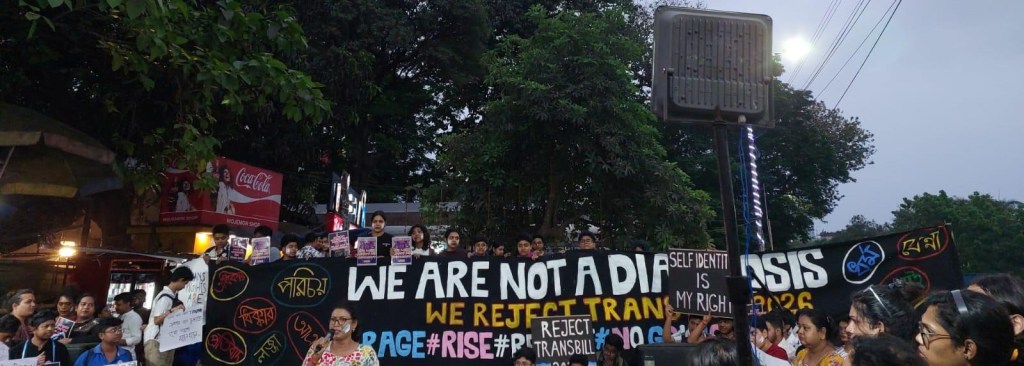
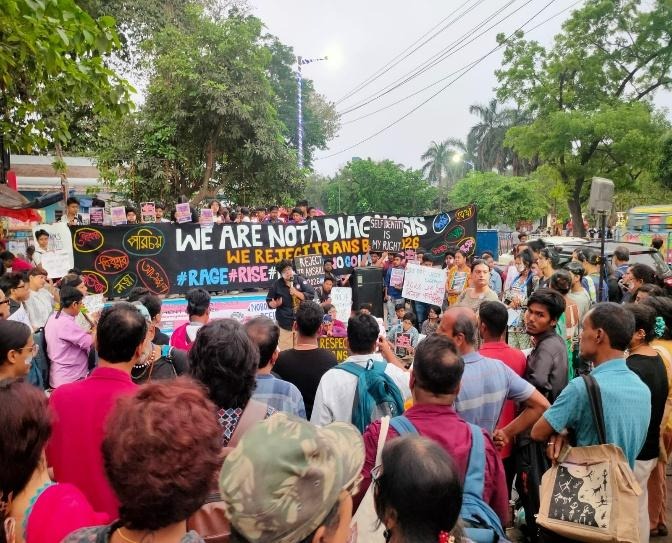
On 15th March, 2026, at a public event in Ranu Chhaya Mancha, Rabindra Sadan, a protest unfolded with slogans against the Transgender Rights Amendment Bill, alongside calls for alliance and unity among all groups fighting for equal rights and justice. Transgender activists, scholars, students, queer individuals from diverse backgrounds and professions, and allies concerned about transgender rights in India gathered around the elevated platform. The dangers of the new Act were reflected upon against the backdrop of the broader onslaught of violence and exclusion that transgender individuals already face in education, the workplace, the family, and the medical domain. A major point of contention was Section 18 of this Amendment that criminalised transgender individuals who, if proven to force or coerce a person to “become” transgender through forceful influence or surgical and hormonal procedures could be jailed for ten years. This comes in the backdrop of the fact that if a transgender person faces sexual abuse and violence, the perpetrator shall be jailed only up to two years. This insinuates something that is much grave than it seems – the government finds transgender people or queer rights groups helping out young transgender individuals accessing knowledge about gender affirmation as bigger criminals than someone perpetuating sexual violence against a transgender person. Open rejection of the Amendment and refusal to give up one’s dignity in proving one’s gender through a removal of clothes in front of a medical board, coloured the unified voices with multiple conversations intersecting the strategies that ought to be followed as a path to deal with the Amendment and reject it. “Do cisgender heterosexual people have to open their clothes, prove their gender in front of a medical board according to the size and shape of their genitals? If not, then why should we?” – exclaimed Anurag Maitreyee, a transgender and cultural rights activist on the microphone. “We are not your Diagnosis”, read a banner that stood tall among others, colouring the space in rage and solidarity. Larger conversations surrounding transgender lives in rural areas, intersected with lack of access to employment opportunities, education and healthcare in general, which is not just minimal, but in a regressive state, due to the absence of gender and sexuality sensitization in these spaces. Grieving voices intersected, while pondering upon the impact this Amendment can have on Dalit, Adivasi, Bahujan, rural and Muslim transgender people. In rural spaces where government hospitals hardly function to provide proper healthcare, one wonders how mandatory gender affirming care would even be provided, let alone form a medical board for a transgender person to “prove” their gender.
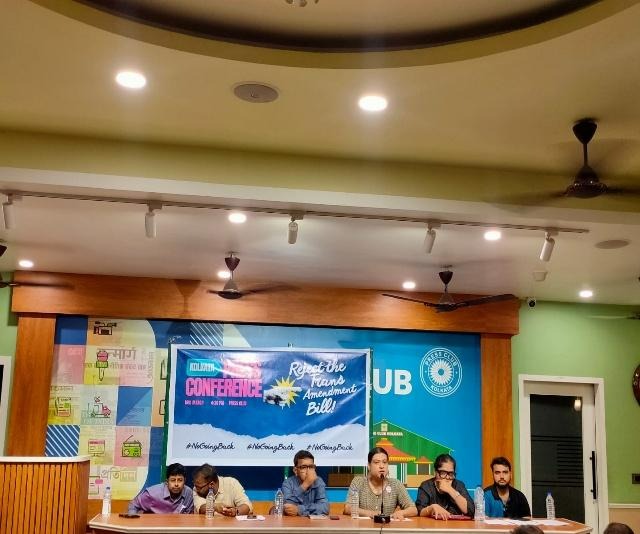
The call for a larger movement has been followed by organisations all over the country calling for rallies, protest events, discussions, sensitization and demand dissemination events. College and University students have formed a larger queer trans alliance group in West Bengal with various colleges and Universities encouraged to form their own committees for being a part of the larger movement. Accumulation of information about mental health service providers, therapists and counsellors were shared around communities on social media, WhatsApp groups and distress call management has now become a part of daily work for transgender activists, Community Based Organisations (CBOs) and Non-Governmental Organisations (NGOs) in West Bengal. Unifying calls for ‘no going back’ and demands for taking back this draconian law are circulating within and beyond communications between transgender and queer individuals all over social media and public forums. Only time shall be a testament for this struggle that marks a new page in the history of the transgender and queer movement in India.
By Meghjit Sengupta
Meghjit (they/he) is a PhD candidate in the Department of Sociology, Jadavpur University. Meghjit serves as a Guest Faculty and is a UGC-NET qualified Senior Research Fellow (SRF) in the same department. Meghjit has completed B.A. (Hons.) in Sociology from St. Xavier’s College (Autonomous), Kolkata, M.A. in Sociology from Presidency University, Kolkata and M.Phil in Sociology from Jadavpur University. Their research interests lie at the intersections of queerness, boyhoods, masculinities, and gender performance, explored through an ethnographic and self-reflexive lens, situating personal experience within broader sociological and queer theoretical frameworks.
 Sabr: A care collaborative
Leave a comment