
Threads of Care – Weaving Solidarity in an Unlivable World – with Samita
The Sabr Collaborative penned this photo essay to accompany Samita Chatterjee’s powerful cover image for us.
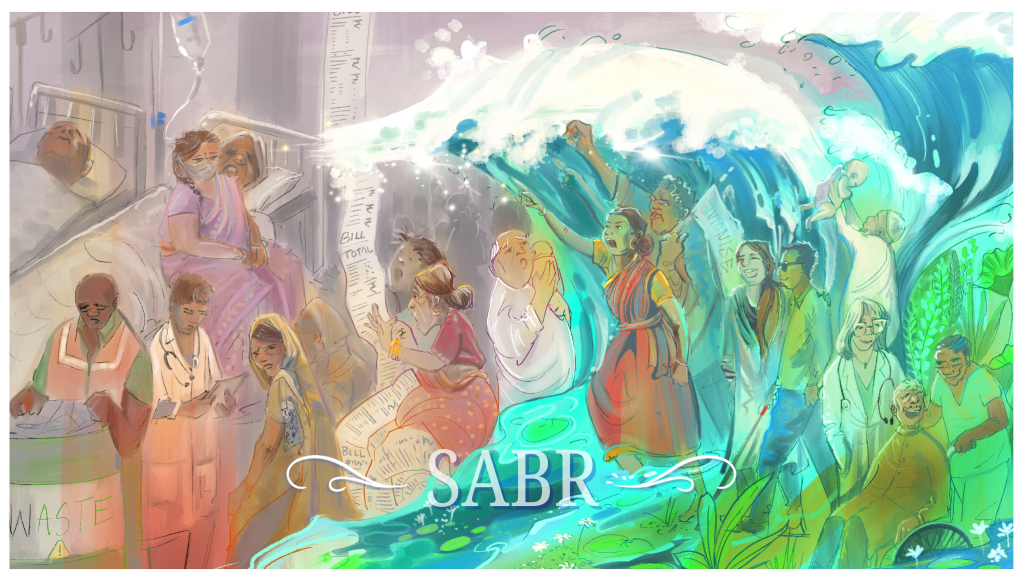
The frame captures what makes this world both unlivable and potentially livable.
On the one hand, we see the faultlines that mark this world – families staring at medical bills that could push them to debt, patients left alone at a hospital bed because their families cannot afford to miss a day’s wages, overcrowded hospitals where patients wait for hours, overstretched nurses, and sanitation workers whose caste determines their proximity to waste and distance from dignity. These are not isolated struggles but interconnected symptoms of a system that profits from keeping care private, invisible, and individualized. Care morphs into a burden instead of a basic right, absorbing the unpaid work of social reproduction that subsidizes an entire economy.
On the other hand, we also recognize and foreground the labor that constructs everyday infrastructures that sustain this world — healthcare workers and domestic workers who wake before dawn to care for other people’s children, elderly parents, and disabled family members while their own families wait at home.
There are glimpses of hope and radical collective reimagining that emerge. Within this frame, Samita documents the seeds of transformation emerging from the crack of the broken system: people’s voices against social discrimination, healthcare workers holding protest signs demanding dignity, and the everyday revolutionary act of people choosing to help each other despite a system that thrives on their separation. Through this contrast of struggle and solidarity, re-imagining caring is our deepest crisis and our greatest hope.
Re-paired – with Dr Amrita Sengupta
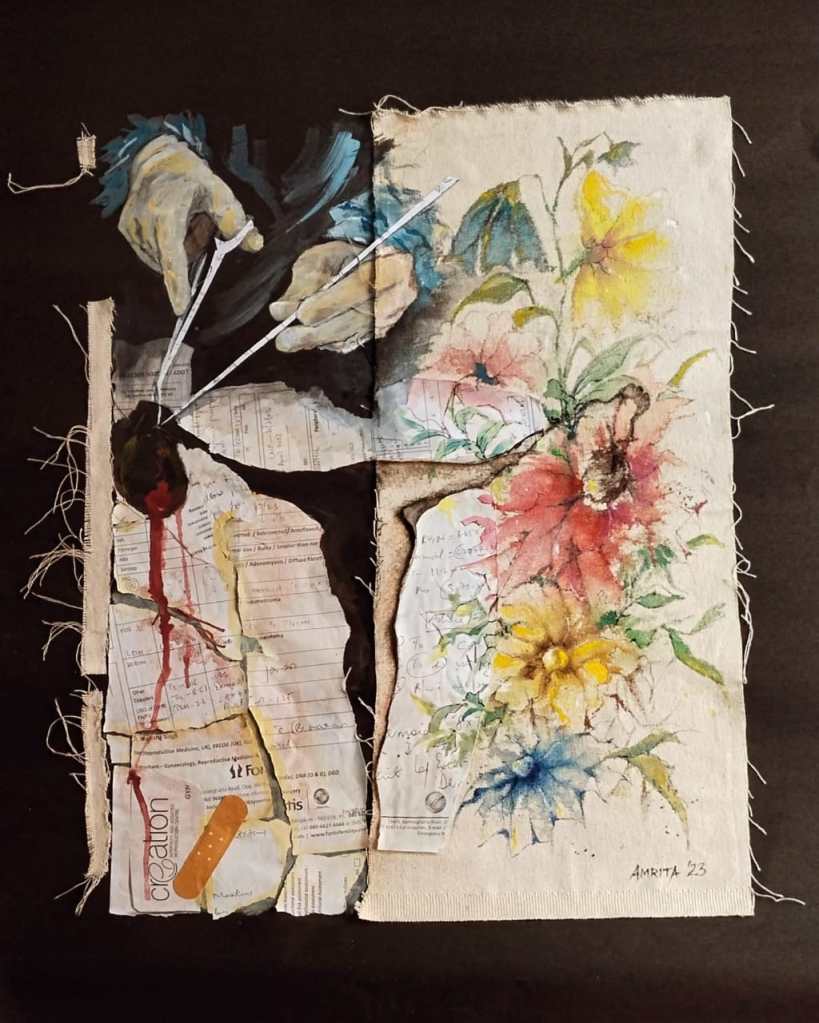
"Very non-artistically, my right ovary has been drilled and cut twice, that is where you see the surgeon's hands. The left ovary is fine and blooming.
Metaphorically, we expect everything should be perfect and happy. But life is seldom so.  Life is infact filled with broken dreams, unfulfilled dreams. And we try to mend those imperfections gracefully; accepting them and also, loving them".
Amrita was born and raised in Kharagpur, a small town in West Bengal. Raised by a single mother made her independent and responsible from a young age. Both her grand parents were teachers, to whom she owes her honesty, diligence and simplicity. Her appreciation for arts and sciences come from her parents.
Amrita completed her B.Tech in Mechanical Engineering from National Institute of Technology Durgapur. Following this she joined the Tata Motors for a brief stint of 2 years. Her interest in diving deep into the fundamentals of a problem swung her back to the academia. She pursued her M.Tech (Jadavpur University) and Ph.D. (Indian Institute of Technology Kharagpur). With a coveted Ph.D. degree, she made a transition to the industry. This aside, she is an artist and feels art is a powerful medium to make a difference.
Here’s Sampriti Majumder’s Care Imagery for Sabr!
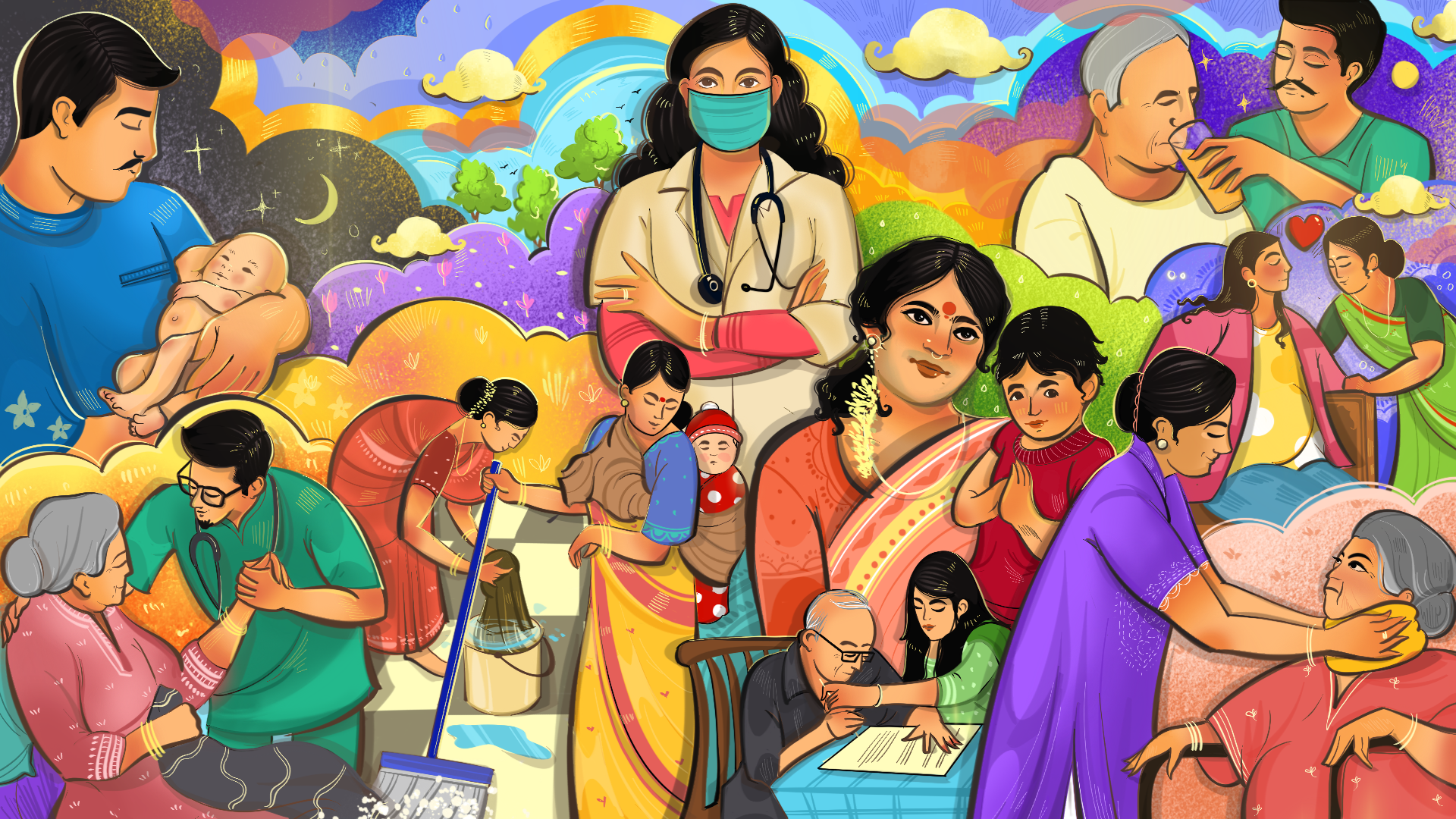
ওরা কাজ করে (Ora Kaaj Kore): Heights of Care – with Sayendri Panchadhyayi

Sanitation and domestic workers form crucial infrastructures for the upwardly mobile, middle-class and affluent families in urban life. Invisibilized, these care workers in gated estates make the domestic and support architecture of hyper-residences in the metropolis while compromising their well-being, health, family and leisure.
Despite their essential work, they are treated as expendable subjects, not lent dignity of labour and work under hazardous conditions. Historically, women from oppressed-caste groups have been pushed to undervalued care work. They remain devalued and underpaid, an indication of the nexus between caste, labour and gender.
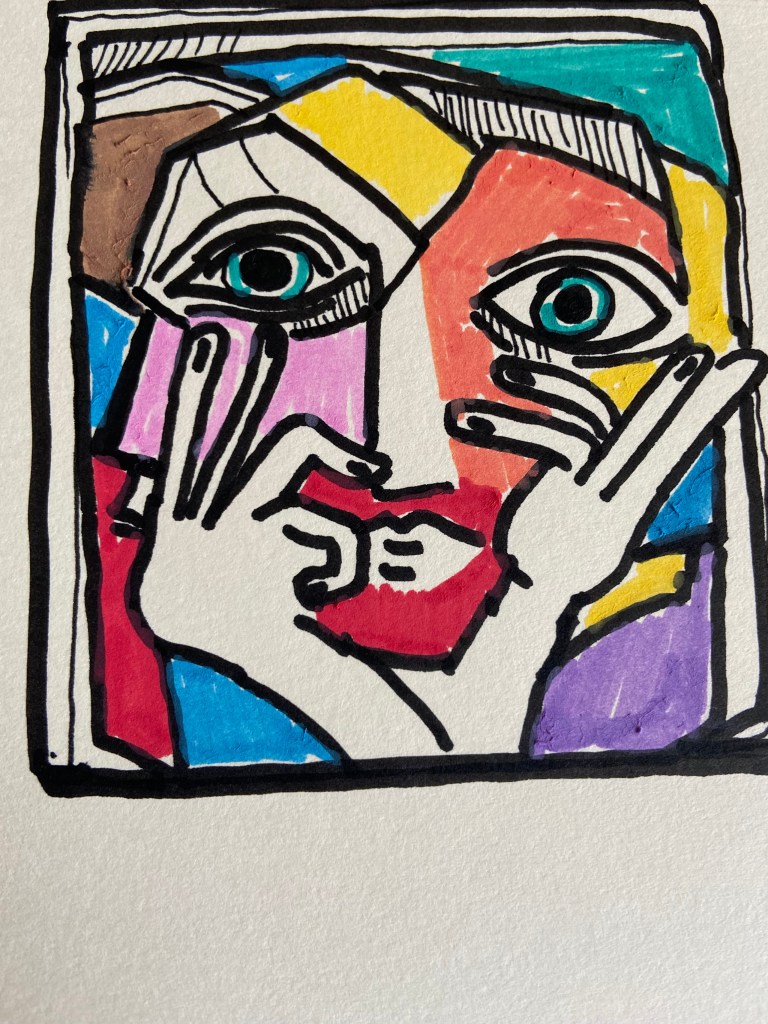
Care and Depletion – with N. Vijay Mohan
Care can be generative, strength-giving, reparative. It can also be depleting and anxiety-laden. Art work for Sabr by N. Vijay Mohan
 Sabr: A care collaborative