Aakriti is a final-year medical student at MGIMS Sevagram, Maharashtra. She entered medicine to understand the diseases and the intricacies of the human body, but fell in love with lives and stories that go beyond the development of a Disease and understanding the word ‘Care’ in healthcare. For Sabr’s March edit, Aakriti generously shares her…
Aakriti is a final-year medical student at MGIMS Sevagram, Maharashtra. She entered medicine to understand the diseases and the intricacies of the human body, but fell in love with lives and stories that go beyond the development of a Disease and understanding the word ‘Care’ in healthcare.
For Sabr’s March edit, Aakriti generously shares her reflections from a recent elective posting in Melghat, Maharashtra.
I had the opportunity to visit Melghat [Maharashtra] during my elective posting. Though the visit lasted only a week, it was emotionally dense—both enriching and unsettling. I encountered a reality very different from the ones I usually inhabit. Cities like Mumbai or Delhi represent one kind of world; Sevagram, where I study, another. Melghat and its people revealed something else altogether.
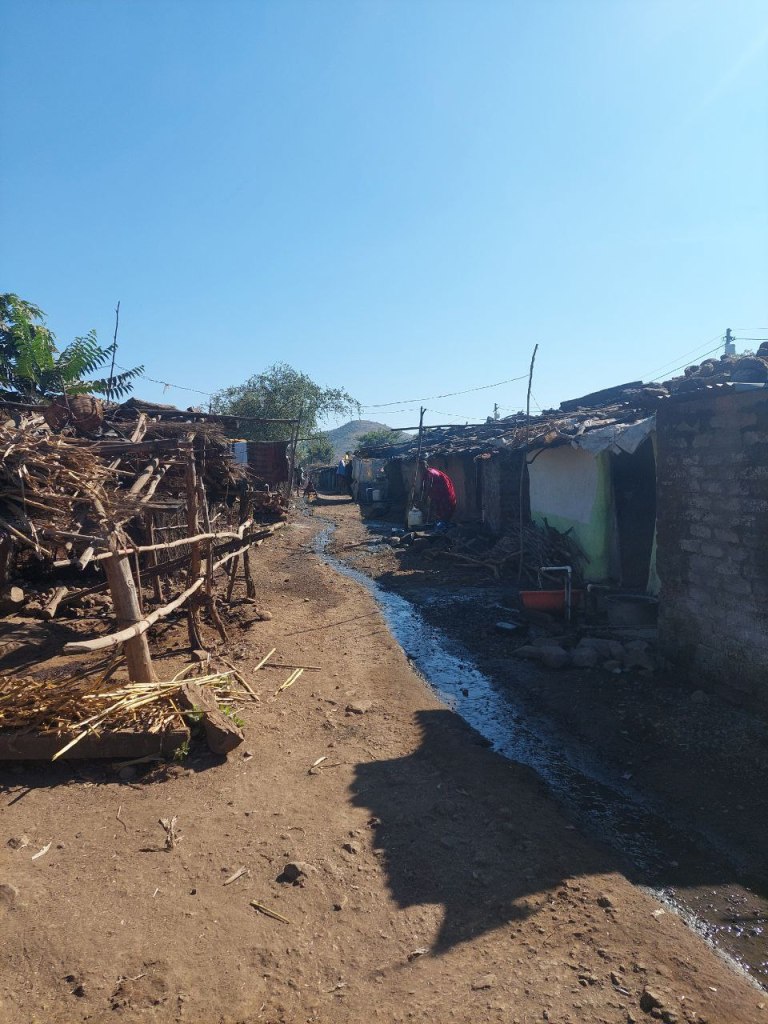
It is a hilly region wrapped in dense forests and tiger reserves. While towns like Dharni resemble other semi-urban spaces, the interior villages tell a harsher story — poor sanitation, fragile livelihoods, and limited access to basic amenities. The region is predominantly inhabited by Adivasi communities, many of whom speak Korku and some speak Gondi too. For generations, they have lived with the forest, developing food systems, health practices, and knowledge deeply rooted in nature.
Patched houses line a narrow lane where water quietly flows through everyday life. Above it all, the open sky carries a quiet, a steady hope.
What stayed with me was the dissonance between these long-standing ways of living and the rapid, imposed transitions labelled as “development.” Tiger sanctuaries and designated, surveilled conservation areas, ashram schools to bring Adivasis to the mainstream, markets and a money-based economy that breaks up barter and communitarian ties and laws brought in or interpreted to disinherit Adivasis of their ancestral land for ‘development’. Were these communities ever consulted before being asked to change? And more fundamentally — who decides what development actually means?
Our elective postings involved visits to villages around Melghat, using transect walks and Participatory Learning Activities to understand community health. During one focus group discussion on anaemia, the conversation shifted naturally toward traditional food practices. The eldest man (about 80s) in the group began naming forest vegetables they once ate regularly. He said that in those days, problems like anaemia, chronic fatigue, or lifestyle diseases were rare. Infectious diseases existed, then and now—but nutritional disorders were uncommon. Silence followed him.
Listening to him, I realised how closely health had once been tied to everyday access to the forest. What puzzled me was that forests still surround Melghat, yet they feel far removed from village life. Communities that once lived with them now speak of the forest as a regulated, distant space—entered with caution, if at all. Even as conservation narratives grow stronger, access to ancestral lands has narrowed, pushing people to the margins of landscapes they once nurtured. In this separation, livelihoods shift and ways of knowing and being —of food, seasons, and health — quietly begin to become hazy.
When he now asks his grandchildren to eat those same foods, they dismiss them as Jadi -Buti — medicinal herbs, not food. “We only bought salt,” he said quietly. “Everything else came from nature.” That sentence lingered with me. If food systems once ensured diversity and nourishment, how did they disappear so completely?
How is it that what was once home slowly becomes a resource: firewood gathered sparingly, land cleared for maize, value measured by markets rather than memory. The forest remains, but increasingly as a symbol of conservation, ecotourism and development, while its older role as a living classroom, kitchen, and pharmacy fades from everyday life.
How is it that what was once home slowly becomes a resource: firewood gathered sparingly, land cleared for maize, value measured by markets rather than memory.
A friend who had worked with farmers to promote Sustainable Non-Pesticide Agriculture practices and was working with a grassroots organization – Samaj Pragati Sahayog (which works with residents of the region to strengthen Agriculture, Watershed-Management, and Health too), helped us understand this shift further. He spoke about earlier farming practices — multiple crops grown together, each at its own pace, each harvested in its own time; farm to kitchen. Today, monocropping dominates, especially maize, driven by claims of feasibility, market incentives, government subsidies for hybrid seeds and pesticides, and imminent climate stress. In ecologically fragile regions like Melghat, the effects of climate change show up early and harshly, reshaping agriculture and livelihoods.
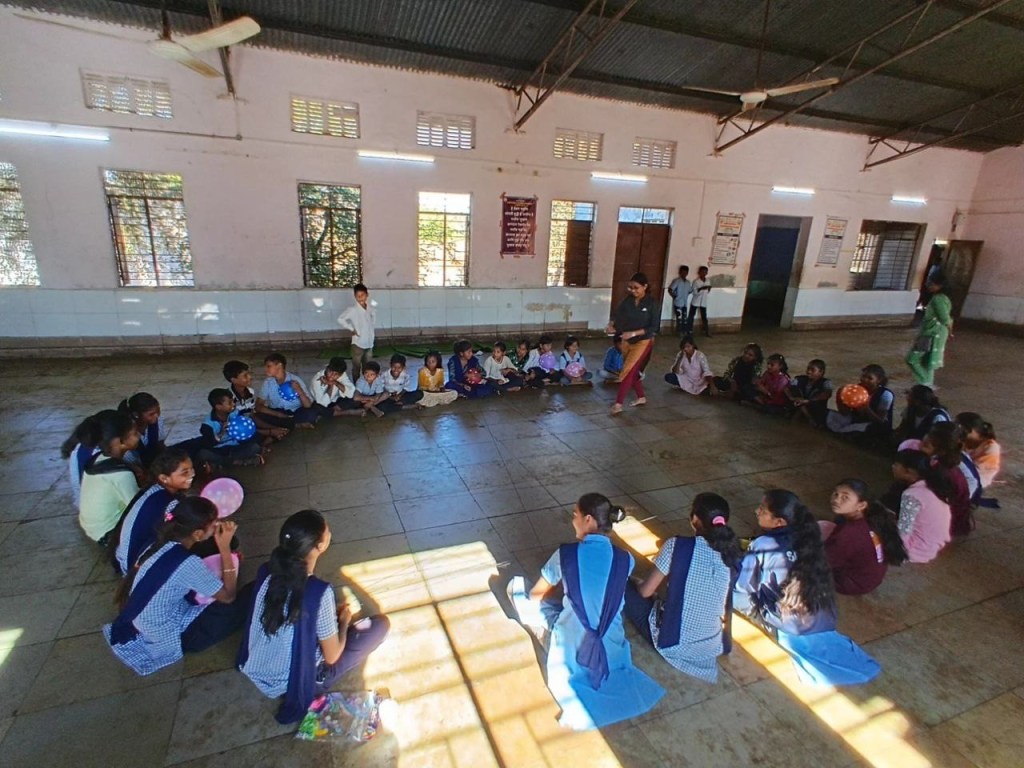
One of my most difficult visits was to an Ashram School—a residential school for tribal children. The day we arrived, there had been no electricity or water since morning. When I asked the children about their favorite food, many answered together: dal-chawal. They said they rarely ate anything else at school. Back home, they always enjoyed meat. One child mentioned they had not had drinking water since the previous day. Another spoke of half-cooked khichdi and crying themselves to sleep.
I couldn’t sleep that night.
What unsettled me was the contrast. These same children played energetically all day—without water, without complaint. I realised I live in two worlds: one where eating out is a choice, and another where food and water are uncertain. Recognizing this privilege brings guilt, but guilt alone feels insufficient. It centers my discomfort rather than their reality, and risks becoming a private emotion that demands nothing of the structures that allow such contrasts to persist. The children did not complain—not because there was nothing to complain about, but because this was the world they had learned to inhabit.
I wondered how often resilience is admired without being questioned, and how quickly suffering becomes normal when it is not our own. Sitting with that thought, I felt that the task is not to feel guilty, but to remain unsettled—to let that discomfort interrupt the comfort of returning to a world where water, food, and choice are never in doubt.
As I reflected further, questions around education surfaced — not as debates, but as a quiet grief. There is constant talk of mainstreaming and formal schooling, but I began to wonder what kinds of learning were being overlooked. Much of what children once learnt followed a rhythm and order of its own—through observation of the elders, engagement and experimentation, repetition of mistakes, and gradual responsibility. Knowledge moved carefully through stories, songs, proverbs, and shared labour, transmitted orally across generations, by the fire side, in the fields and forests, and in the youth dormitories and ghotuls. It was not accidental or unstructured; it was embedded in daily life, in seasons, in relationships. It made me wonder whether sciences, humanities, and accounts truly exist only within classrooms and textbooks — or whether they once lived elsewhere too, woven into seasons, soils, stories, and survival.
For a culture, a people and their worldview where most learning is by seeing and doing, is experiential and procedural and is only when required communicated orally in the form of poems, refrains, stories and riddles, embedded in community apprenticeship and has a village forest as a teacher, what really is an education?
Is it the one learnt in schools where all learning is largely declarative , embedded in hierarchies with ‘development’ as an aspiration not just for students but also for their parents?
When we asked the children about their dreams, some answered—driver, nurse, teacher, police officer. One boy even said, “IPS officer,” smiling as he added that they get to sit and order their subordinates. I couldn’t help but notice the quiet logic in his words: in a place where buses barely run, taxis become the lifeline between villages, and drivers hold a certain power in movement itself.
We created a dream web with connecting threads, where each one passed a thread to each other, saying what they wanted to be when they grew up.
Some children stayed silent. I wasn’t sure if they hadn’t thought about the future yet, or if dreaming felt too distant when daily life already demanded so much endurance. I thought of a line I once heard: a child’s book should act as either a mirror of the world they live in, or a window into other possible worlds. I wondered what mirrors or windows children in the ashram schools were being offered. Their textbooks rarely reflected their forests, foods, or languages. And the windows often opened into worlds so distant they felt unreal.
…a child’s book should act as either a mirror of the world they live in, or a window into other possible worlds. I wondered what mirrors or windows children in the ashram schools were being offered. Their textbooks rarely reflected their forests, foods, or languages. And the windows often opened into worlds so distant they felt unreal.
Melghat did not leave me with answers. It left me with images that refuse to fade—children playing without water, elders naming plants that have no place in textbooks, meals remembered more vividly than meals eaten. It showed me that development does not only change landscapes and livelihoods; it decides what is worth remembering. And when knowledge is not documented, it does not disappear loudly. It fades quietly, taking entire worlds with it.
Now, when I sit back, thinking of all of this as a concept, I wonder whether education could also be a space of repair and healing. Not an education that replaces one world with another, but one that learns to hold many at once. Much of formal schooling quietly teaches children what to value and what to leave behind, often without naming the cost of that separation. Over time, this can create a distance—from land, language, body, and ways of knowing that once felt natural.
In this context, the work Shanti does through the Community Living Library feels like a gentle possibility. The books she shares offer mirrors and windows together—stories that reflect children’s forests, cultures, and questions, while also opening pathways to wider worlds of justice, care, and imagination. They do not ask children to step away from who they are, in order to learn, but allow learning to begin there. Whether such spaces can help mend what has been quietly fractured by dominant education systems is something we all must sit with.
Sabr Collaborative Post-Script: If you would like to connect with Aakriti, and in particular, know more about and support Shanti’s Community Living Library, please write to:
In the article, Aakriti writes about Shanthi’s library. Below, is a brief about ‘Korku Vachanalay’ or the People’s library:
Shanti started a library in September 2022 with the idea that there should be a library for all in Ahad (Amravati District, Maharashtra). The library was named ‘Korku Vachanalay’ which means ‘People’s Library’. Ahad is a village with just over 100 houses with a total population of 564, nestled in the thick forest of Melghat in the Chikhaldara block of Amravati District in Maharashtra. People who live in the village are from the tribal community ‘Korku’ which means ‘People’. Most households in the village do not own land and take up jobs in the unorganised sector to earn a livelihood. Children’s mother tongue is Korku language and Hindi comes second as a language that the children are most familiar with.For generations in the country, marginalized communities have been denied access to reading and libraries. Some of the reasons are social and economic disparity, membership fees, very few libraries that too mostly in urban areas, and lack of efforts to inculcate a culture of books and reading. When a library is free and public, its availability and accessibility for everyone becomes possible. A great library is freedom; to read, think, exchange ideas, entertain, express, ask questions, and receive information. At the same time, it is an important place for the community to dream of a safe world, and happiness and to live with dignity in society. We believe that in the library, in the world of books, in reading, discussing, and thinking together lies the freedom of the community.


 Sabr: A care collaborative
Leave a comment