
‘Humlog ko naukri dene ka arth hi kya hua? Isse acha, hum berozgar hi rehte’ [What is the point in giving us a job? It is better that we remain unemployed.]
In a speech by an ASHA worker at a protest site in Kolkata.
Earlier, there used to be a lot of delays, sometimes 8 months or 10 months of delays in receiving these incentives. Now we get it within 2-3 months. Still, the maximum we can earn is 3-4 thousand or 5-6 thousand, not more than that……. There is a saying- jaisa gud daliye waisa meetha hoga [the amount of jaggery you put in decides how sweet it is going to be]. So, the kind of money that you give decides the kind of work that you get.
Mridula, ASHA worker, Jharkhand
In recent years, we have witnessed nationwide protests and agitation by thousands of ASHA workers, rallying for their recognition as formal employees, demanding an increase in their honorariums, and improvements in social security benefits.
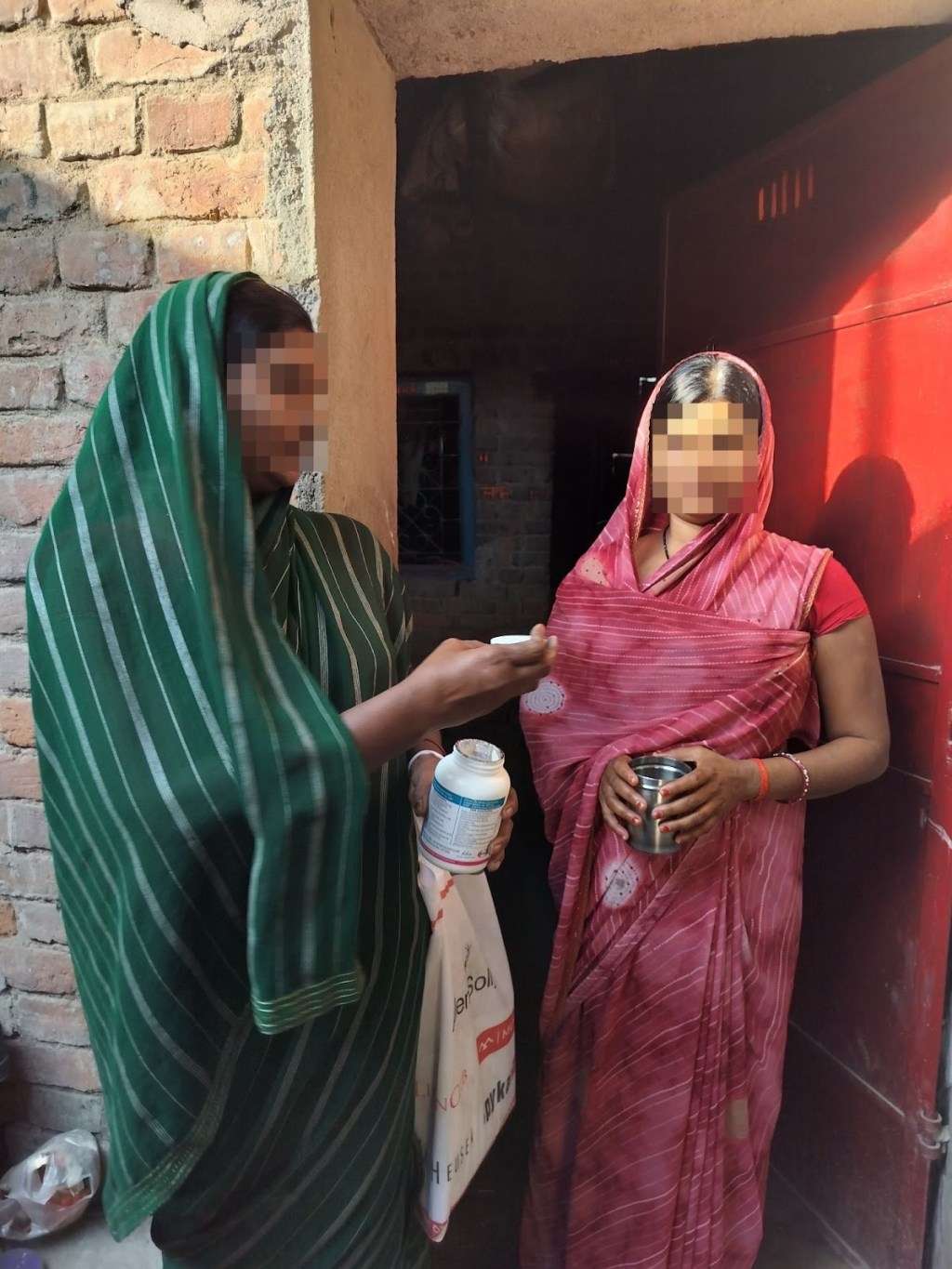
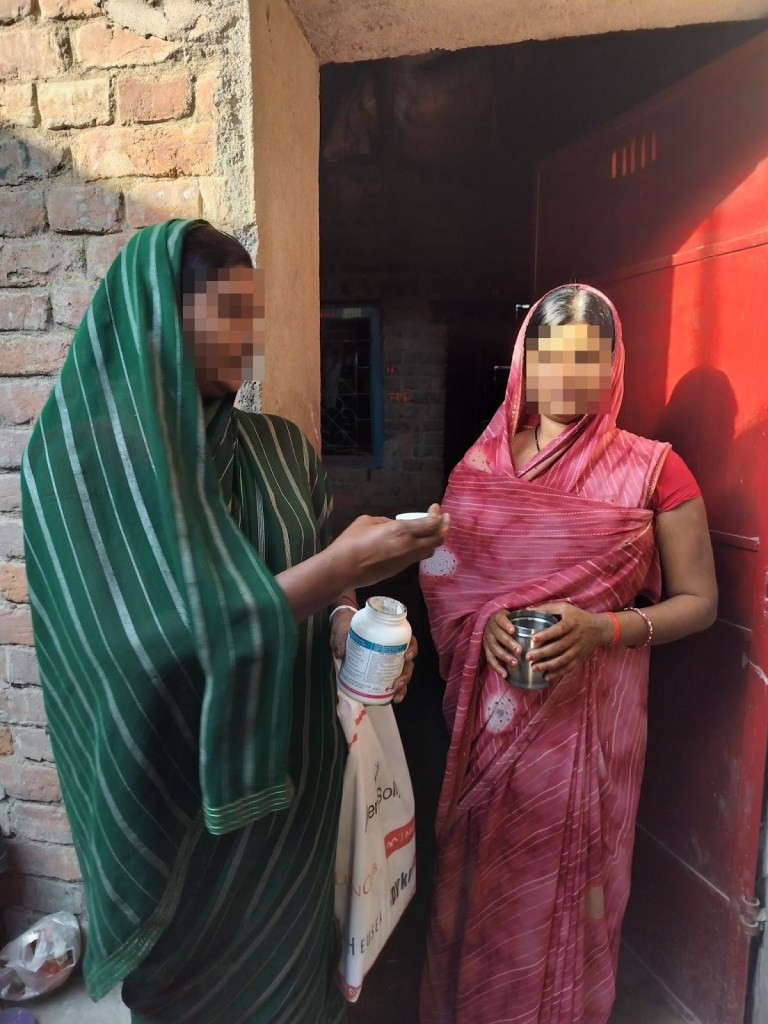
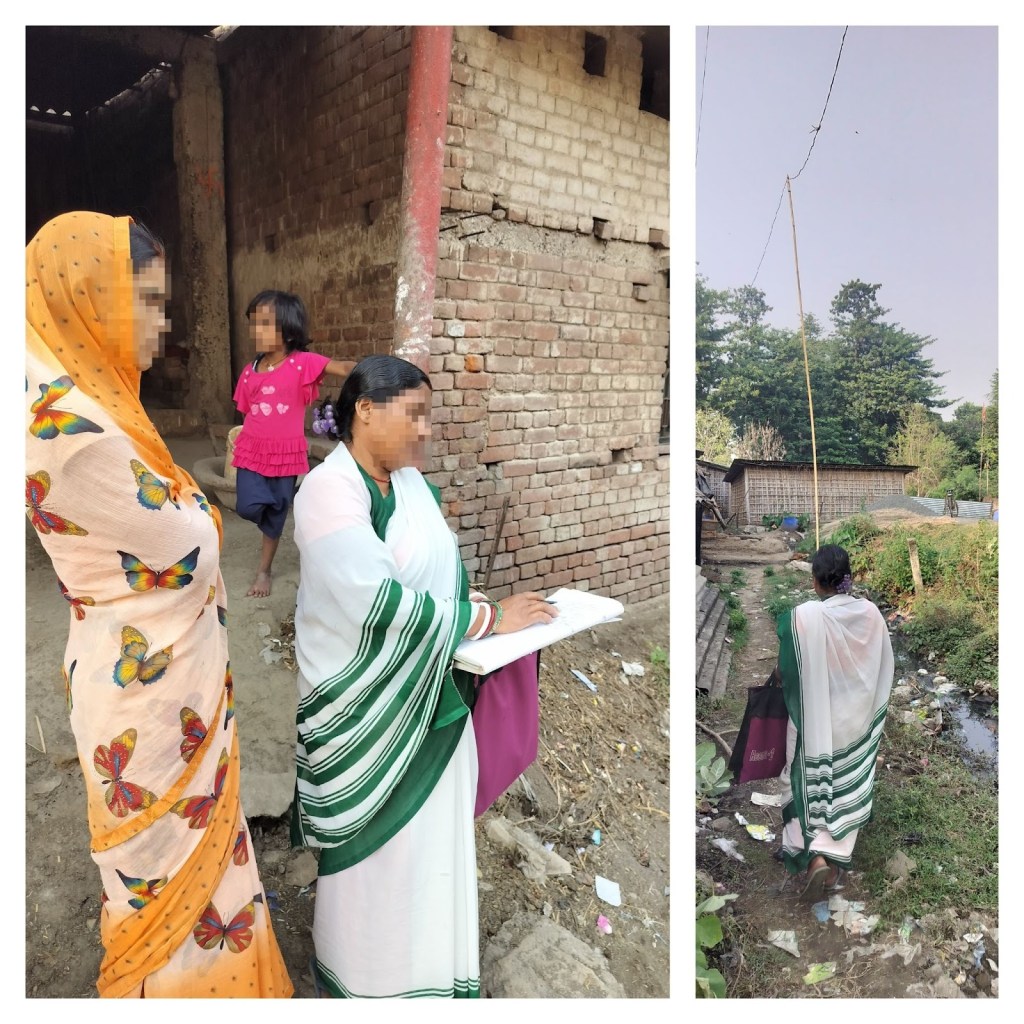
For this Sabr essay, Shaima and Shalini spoke with ASHA workers in Kerala and Jharkhand to capture their experiences as frontline care providers. We occasionally accompanied them on their door-to-door rounds for health checkups, disease surveillance, and the distribution of essential medications. They shared their journeys as community health workers and their reflections on diverse facets of their lives and labor. These included accounts of their financial struggles due to inadequate remuneration and of managing the domestic sphere alongside their jobs. Women also shared instances of workplace hostility and how they navigate patriarchal norms. Their narratives highlighted the ambiguity of their responsibilities as public health workers, their frontline experiences during the pandemic, and their collective, ongoing journeys of solidarity and resistance. This is the second in a series of essays on ASHA workers.
Despite persistent police obstruction, ASHAs continue to stage protests and have used diverse means to practice and advance their politics of visibility by organizing candle marches, conducting hunger strikes, staging demonstrations, occupying spaces near critical public offices, disrupting political rallies and speeches, bycotting training programs, and even shaving and cutting their hair as a sign of protest, thus opposing the capitalist assault on their rights and dignity as careworkers. They have been intimidated, sacked, criminalized and assaulted for expressing dissent, and continue to face frequent threats for termination of their services. ASHAs have retaliated against this suppression by observing black day in Kerala, Dhikkar Diwas (Day of Condemnation) in Kolkata, blocking police jeeps, and conducting rallies. Over time, their movement has gained traction, drawing support and appreciation from activists, civil society and other social movements and organizations.
If you consider the number of strikes we held to secure our rights, you will understand it. In recent years, we have begun protesting to secure our rights at work. We started receiving wages for the jobs we do through the many protests we conducted, and we were successful. We started the protest for our rights around 2017. And whatever perks and benefits we achieved, we fought for and earned. Therefore, the current strike, which is ongoing, is not a sudden occurrence in the history of ASHA workers. That is our community’s strength, which has brought us to where we are now. No government has given us all those benefits as our right. We really fought for it and earned it. That is why we continue to strongly support the ongoing protest. If we don’t raise our voices for our rights, we will still be standing where we were 15 years ago, says Savitha.
The political backdrop in which groups mobilise and organize protests is equally important. Our interviews revealed that geographical inequalities stemming from the state’s infrastructural capacities and the region’s history of social movements significantly shaped how ASHAs mobilized and negotiated these challenges. In one of the remote Jharkhand districts, ASHAs found it difficult to continue their protests. When they raised their voices, public officials reminded them that they are disposable and easily replaceable. “We were told, ‘Bohot dikkat hai toh kal se kaam pe mat aaiyega’[if you have so many issues, do not come to work tomorrow onwards,” says Kavya.
We staged a protest in 2022. …. But they started threatening us by saying that “whoever will protest, we will remove them and re-elect new sahiyas.” The C.S. (Civil Surgeon) here and even a journalist told us that no matter what you do, your pay will not be increased, and nobody will listen to your demands. What can we do when they start threatening us like this? shared, Mridula.
We asked Parul, an ASHA worker in the same district, to share her thoughts on the ongoing protests by ASHA workers in Kerala and other parts of the country. She replied, “How will I do it, didi? For this, all the sahiyas will have to be united. Only then can we do this, right?”
Interviewer: So why can’t you unite and raise these concerns?
Parul: They (ASHAs) just don’t come. To your face, they will say, ‘Let’s go,’ but later they will back out. And here, the department is such that whoever speaks will suffer… If we go and raise our voices, then immediately 3-4 people from the office itself will start saying, ‘Look, she is talking a lot. ’
Interviewer: Do they intimidate you?
See, there is no unity here. Outside, all sahiyas are united, and they protest together. We once protested outside the CS (Civil Surgeon) office. There were sahiyas from both the gramin and the urban areas. So they sat for the protest for one day, and from the next day onwards, people from the department started intimidating us. The sahiya sathi (an experienced ASHA worker who trains newly recruited ASHAs) from the gramin area instilled fear in the 3-4 sahiyas working under her. She said: ‘You will protest? On whose directions are you staging this protest?’ So those 3-4 gramin sahiyas were scared to come. We are 20-22 sahiyas here (urban). What could we have done? Slowly, people scattered. Now you look at Ranchi. The sahiyas there have a lot of unity. Here we don’t have that.
Our respondents also reminded us that their struggle is not merely about remuneration but also about dignity and the right to be heard and seen. There have been reports of violence and frequent attacks on ASHAs at work. Not only do they have to navigate hostile moments on site, but they also have to be extremely patient while engaging with state beneficiaries and government officials.
We are told, ‘Go do the survey. Distribute these medicines.’ We are not supposed to just distribute it. We have to feed them the medicines and make sure they eat them in front of us. If they eat it, it’s fine; otherwise, we have to return them. If an MPW (Multipurpose worker, MPW-M) personnel comes, people are aware that he is from the department. But they know us sahiyas as part of their community, not as department members. So they refuse to eat the medicines and tell us, ‘Go eat these yourself. Feed this to people at your home. I don’t have Falaria.’ … They don’t take us seriously, says Parul.
Being frontline community volunteers, ASHAs are subject to accusations and have to navigate adverse public sentiments towards systemic failures and their distrust in the public health system. While ASHAs in Jharkhand reported a largely negative experience engaging with the community and public officials, Savitha, our respondent from Kerala, shared that she felt deeply trusted and respected not only by the people she served but also by the medical community, which provided her with immense support:
The doctors we work with are our great supporters. They are the ones who urge us to fight against our rights. People like us need leaders like them who understand our needs and motivate us…. Our medical officer takes us on outings on some second Saturdays. He treats us equally and values the job we do. Our MO is very much concerned about our health.
In sharp contrast to Savitha’s account, ASHAs in Jharkhand reported that officials spoke to them harshly and barely acknowledged or addressed their grievances. Mridula shared how public officials and medical professionals often deny them basic professional dignity:
A sahiya has no value. Everyone looks down upon us. We are not even entitled to a washroom. What more can I say? The nurse looks at us as if we are below them. The doctor is at an even higher status. Everyone looks down upon us…. When we visit the hospital, we do not have washrooms (separate). Where do we pee? We are forced to use the patient washrooms. There is a chance of developing an infection. I do not feel like using it. But for how long can I hold it? Nurses have separate washrooms, but they keep them locked. They do not let us use it.
Their knowledge and skills go unappreciated, and their perspectives are often ignored. ASHAs in Jharkhand reported that they didn’t receive adequate training when elected, and it was only in recent years that the emphasis on training and educational qualification in their region has increased. “At first, we had only 9 sahiyas. When we got elected, we just had to submit our documents. We got a 5-day training last year…. Nothing at that time. We just got elected, and we were asked to call all the children and get them vaccinated. ‘No child should be left behind,’ we were told, says Parul.
In Kerala, however, ASHAs reported having to undergo rigorous training and felt more prepared and confident to serve communities in a relatively organized manner. Our interviewees from Jharkhand shared how, despite overextending themselves, they barely get any recognition or respect for the work that they do:
From gramin [rural] to sehri [urban], the poor who didn’t have any work were hired as sahiyas for help. That day, they didn’t ask who was educated and who wasn’t. And in today’s time, the amount of work that a murkh [foolish] sahiya does, going door to door! You try making an educated person do that! Go to the delivery room, and you will find many educated people there. See if there’s someone like us who will hold their hands and feet, and who will take care of them like us! People will cover their noses and leave the room. They won’t even tear a piece of fabric and give it to them. We serve with our lives, says Parul.
Ab hum MBBS toh kiye nahi hain ki poora badan ka jaanch karenge. Aur koi pagal hi hoga. Padh likh ke ye kaam agar koi karega na toh samajhiye naseeb uska jaral hai. Humlog toh begariya hai isliye kar rahe hain ye kaam, [I haven’t studied MBBS to be able to do a full body check-up. And only a fool who has that kind of education will do such work. Even after getting educated, if someone has to do such work, it is a misfortune. We are jobless, and hence we are doing this work] shared Mridula.
Our interviewees shared several instances of corruption in the health department. We also identified violations of government guidelines for selecting an ASHA. Our interlocutor pointed out that urban recruitment, in particular, is marked by “backdoor” appointments that favour those with connections or the ability to pay bribes. Mridula shared how demand for bribes in their region has become the norm:
When we go to submit the forms, we are asked for bribes. If I am supposed to receive 1000 rupees, but they will give me 800 and keep 200 for themselves. They say, “Either give 200, or forget your money.” This is prevalent everywhere. Last time I gave the money. This time I didn’t. I submit all the papers. There is no mistake in anything I submit, yet I don’t get the payment… Just recently, I took a patient to the hospital for delivery, and the nurse demanded some money from the guardian of the pregnant woman. She said she wouldn’t sign my form unless they gave her some money. I told her not to sign the form and said I would raise my voice against it.
In our conversations with ASHAs in Jharkhand, we came across the term ‘link worker.’ Link workers are women who are routinely hired as temporary volunteers to conduct disease surveillance or surveys. Most of the ASHAs we interviewed in Jharkhand had spent several years volunteering as link workers alongside ASHAs and Aanganwadi workers, for little to no money. “For my services as a link worker, I had done the calculation and was supposed to receive a sum of 22,000 rupees for all the work that I had done, but I did not get anything,” says Parul, who was a link worker for over a decade. Many others continue overextending themselves in hopes that their work will be recognized within the community and improve their chances of being elected as an ASHA worker. This opens the door to further exploitation with no recognition or incentives. Mridula, who was a link worker for nearly 8 years before she was elected as an ASHA, shared:
I began my journey as a link worker by conducting vaccination drives for the newborns every few months. I also used to go for DPT (Diphtheria, Pertussis, and Tetanus) rounds, which are given to children after 5 years. This was all I did when I started, but I didn’t receive any compensation for this work….. I did this unpaid work for a very long time. I got no benefit out of this. I got nothing. I spent entire days going door to door, calling kids to vaccinate them and holding them while they were vaccinated. Sometimes people don’t turn up, and I have to call them twice or thrice. Even after that, some won’t show up. In 2020, when there were elections, through the gram sabha then I got permanent and started getting paid.
Despite these challenges, the relationships they form, especially with the women whom they assist with antenatal and postnatal care, the respect that they have earned in the community as frontline caregivers, and the happiness and pride they feel in making their own money were some of the most important things our interviewees valued about being an ASHA. Navya, an aanganwadi sevika who was accompanying the ASHA worker for an immunization drive, shared:
I have seen these kids grow up right in front of me. I know almost everyone in this locality. I have taught their kids and administered their vaccinations. So when they come back to me and talk about their achievements, I feel very content and proud.
Amidst these odds, their endurance, fueled by hope for a change, is undying and relentless. It can be seen in the ways ASHAs have been showing up for work and serving their communities for years. Since they have been pushed to fight for their basic rights for decades, this pursuit might seem rather ordinary or routine, their struggles almost asynchronous with their job titles, their endurance possibly valorized or romanticized, but for Mridula, Parul, and Savitha the endurance, sabr and hope they live with isn’t passive but creates an opportunity to collectively challenge and reimagine the existing and ‘ideal’ notions of care work as gendered and self-sacrificing. By forging solidarities and engaging in transformative action, ASHAs imagine and practice possibilities for an alternative world-making that values care and those who provide it, thus creating ruptures in the dominant capitalist logics and narratives that thrive on relentless exploitation.
By Shaima and Shalini
Resources:
- https://behanbox.com/tag/asha-workers/
- Varman, R., & Vijay, D. (Eds.). (2022). Organizing resistance and imagining alternatives in India. Cambridge University Press.

 Sabr: A care collaborative
Leave a comment