
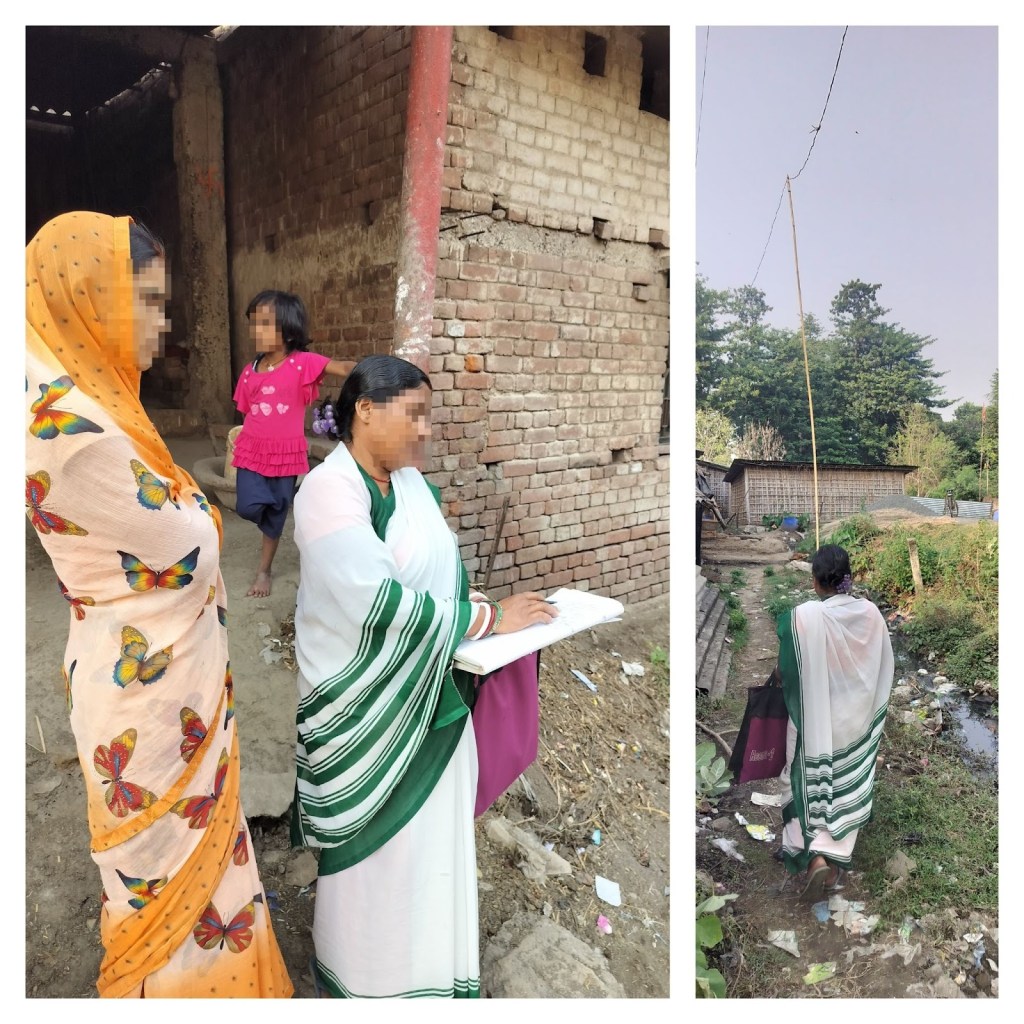
“Last time when you gave him that injection, my son had a fever for so many days. I won’t send him again.” Sceptical remarks like these regarding vaccinations and medications are fairly common sentiments that ASHAs navigate routinely. We watched Mridula as she stood by the door, dispelling myths around vaccination, patiently explaining its side effects, and assuring women of its safety and importance. She showed the register where she had been maintaining records from previous immunization drives and took their signatures. “I remember I visited a family 20 times to convince them to go to the hospital, and finally, they agreed. It is not just one person that you have to convince, but you are supposed to persuade an entire family, which is a really tiring task,” shared Savitha (name anonymised) from Kerala.
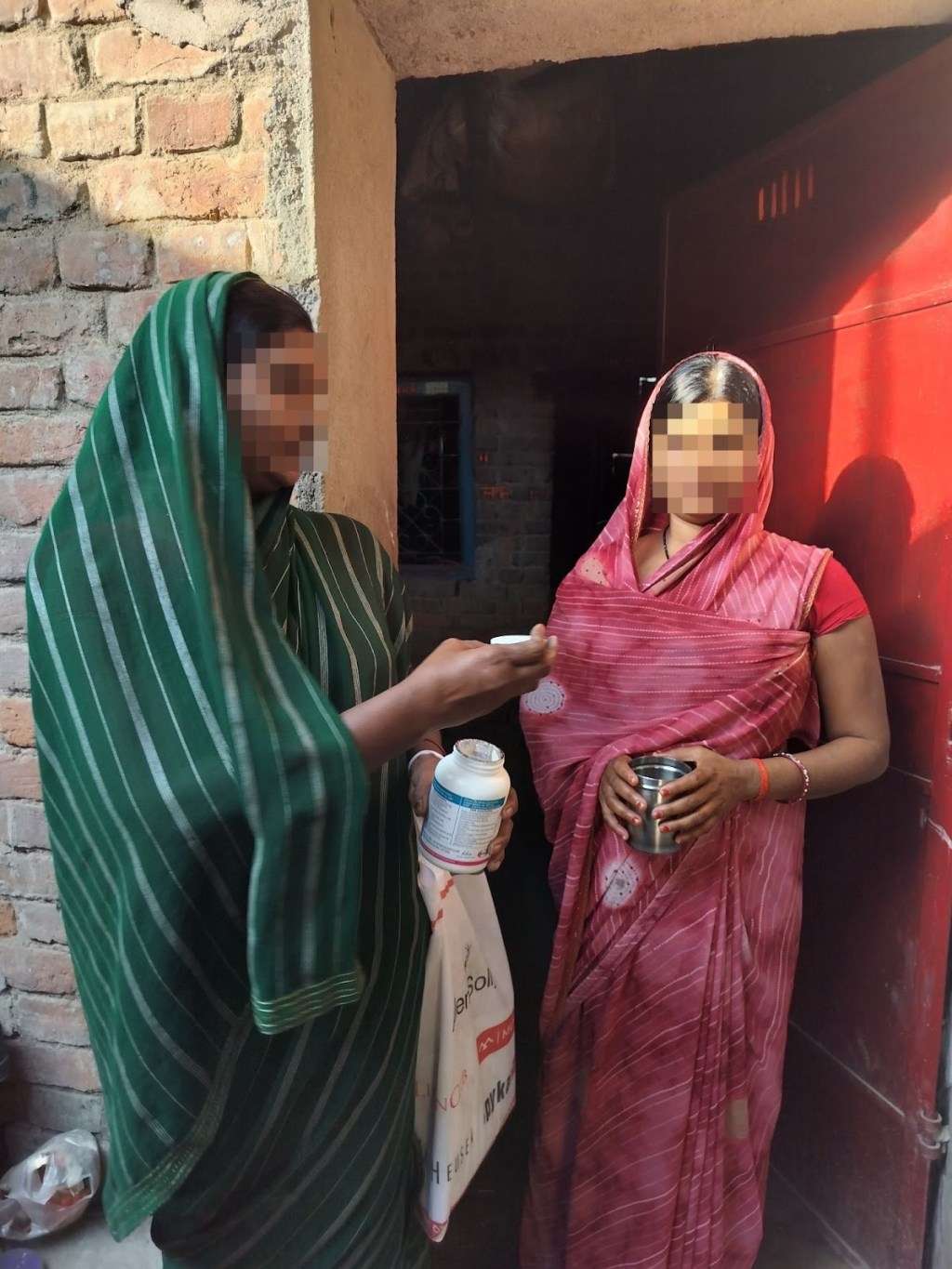
For this Sabr essay, Shaima and Shalini spoke with ASHA workers in Kerala and Jharkhand to capture their experiences as frontline care providers. We occasionally accompanied them on their door-to-door rounds for health checkups, disease surveillance, and the distribution of essential medications. They shared their journeys as community health workers and their reflections on diverse facets of their lives and labour. These included accounts of their financial struggles due to inadequate remuneration and of managing the domestic sphere alongside their jobs. Women also shared instances of workplace hostility and how they navigate patriarchal norms and occupational stigma. Their narratives highlighted the ambiguity of their responsibilities as public health workers, their frontline experiences during the pandemic, and their collective, ongoing journeys of solidarity and resistance.
Launched more than two decades ago, as part of the National Health Mission (2005), ASHAs or Accredited Social Health Activists were recruited as all-women community public health workers responsible “to act as an interface between the community and the public health system” providing the medically underserved citizens with increased access to public health facilities. A bulk of the care labor across the world is borne by health care groups made predominantly of women, who often serve the marginalized communities they belong to. This invisibilized, and deeply gendered, intimate infrastructure of care work is central to sustaining and furthering neoliberalism’s core ideological project of privatisation.
The detailed government guidelines on ASHAs (2005) recognized that the existing roles and responsibilities of an ANM (Auxiliary Nurse Midwife) and the already overburdened Aanganwadi workers [under the ICDS or the Integrated Child Development Scheme] did not “allow her to take up the responsibility of a change agent on health in a village.” As a result, ASHAs were recruited as “community based functionaries,” to “ fill this void.”
The initial guidelines proposed hiring one ASHA per 1,000 population, without specifying any geographic limits. As a result, the actual number of people ASHAs serve in densely populated areas is far higher, while in regions with a relatively scattered population, ASHAs are forced to walk several kilometres to provide essential care services. Savitha, from Kerala, who has been working as an ASHA for over a decade now, shared:
The initial ratio was one ASHA per 1000 population, and there were 2-3 ASHAs per ward… Population-wise, each ASHA is responsible for attending to 1000 people, but for me, it is now around 2700, which is why my workload is higher.
Similar concerns were raised by ASHAs we spoke to in Jharkhand. Parul (name anonymised) narrated:
I have to cater to 352 homes. The population count for that is very high. It is very difficult to cover this area. The area I have been overseeing has remained the same, but the number of homes has increased drastically. In the gramin (rural) area, the workload is relatively less. Here, we need to elect more sahiyas.
Sahiya is a colloquial name for ASHA workers in Jharkhand.
The current crisis of care isn’t sudden, and the wave of protests by ASHAs that we are witnessing, their fragility and precariousness, was inevitable and finely written into the guidelines that assigned ASHAs the status of ‘honorary volunteers’. Despite recognizing their critical and indispensable role in the Indian public health system as ‘change agents’, and burdening them with an overwhelming list of responsibilities that could “be enhanced subsequently,” ASHAs were given no fixed remuneration and had very limited social security benefits. Even the most recent labor codes (November 2025), aimed at extending social security benefits to the organized and unorganized workforce, use this nomenclature of ‘volunteer’ to exclude ASHA and Aanganwadi workers from availing these welfare benefits. Volunteerism becomes a technology adopted by the state to facilitate care extraction by stripping its public health workforce of basic welfare benefits and minimum wages in the guise of moral duty. It furthers systemic deprivation by suppressing the very people who uphold the state’s fragmented health infrastructure. The initial set of ASHA guidelines dictates:
ASHA would be an honorary volunteer and would not receive any salary or honorarium. Her work would be so tailored that it would not interfere with her normal livelihood.
This phrase ‘normal livelihood’ could be amusing, even laughable, if it did not obscure the harsh material conditions of the ASHA’s full-time work. ASHAs have a physically demanding job, typically involving long, strenuous hours nearly every day of the week. For those residing in remote and inaccessible regions, ASHAs are often the only point of contact for availing healthcare.
With delivery patients, we have to go whenever we are needed. If I get a call now, I will not be able to talk to you. I will have to ask you to come later. Someone will come when I am cooking- ‘please come over and check the patient’, and I have to leave everything and go with them. Whether I have eaten or not, I will have to go. I do so much work, mostly in the field, and still I get paid so little, says Sarita from Jharkhand.
An ASHA story from Haryana documented by Behanbox, a digital archive of gender diverse stories, shows how, despite their recruitment as volunteers, ASHAs are discouraged from holding other job positions simultaneously. Despite this ambiguous and overwhelming workload that keeps increasing by the day, this deeply exploitative incentive structure remained stagnant for a long time, and it was not until 2013, almost a decade later, that ASHAs began receiving a fixed monthly honorarium of 1000 rupees. This amount was later revised to 2000 rupees in 2018. Reflecting on how unfair and humiliating it seems to continue doing so much work for such meagre pay, Mridula shared:
2 lakhs! 2 lakhs! Two thousand would mean two lakhs only, right? Hence, they can make us do so much work, right? (smiles sarcastically). We must be getting 2 lakhs for so much work. Hmm? Say? I feel ashamed even saying it. They load us with so much work! When a home guard on duty is at work, the government pays him 30,000 rupees. They are given 30,000 rupees, right? And a saiyah does such dirty work! We are told ‘go collect stool samples, collect urine samples, collect spit and sputum samples’. Now tell me, am I going there to get the patient treated, or am I going to get a disease for myself? I don’t want to do it. We are asked to collect sputum samples of TB patients and deliver them to the laboratory. Should we be asked to do so much work for merely 2000 rupees? Such dirty work? Is it enough, you tell me? (her voice filled with pain and rage). How will I get someone else’s cough treated when I myself am not safe? What facilities do we have? Are we given anything?
Commonly referred to as the backbone of the Indian healthcare system, ASHAs have become a household name and are often the initial touchpoint for healthcare in rural India. They predominantly come from low-income family groups and marginalized communities such as tribal, dalit, and adivasi populations, and compensate for the massive inadequacies of a crumbling and insufficient public health infrastructure. Their roles? Ambiguous! Their training? Inadequate! The contemporary neoliberal regime that relentlessly pushes for privatization, resulting in reduced public spending on essential health infrastructures, further sustains, reproduces, and amplifies these pre-existing inequalities, creating a void and exacerbating the ongoing crisis of care. Women on the margins who bear the lion’s share of responsibility for care labor are the most affected and face the brunt of a fragile political system designed for extraction and exploitation with minimal incentivization. We see how caregiving traits are feminized through expectation and repetition and how gender becomes an organizing principle for care work.
The extent of ambiguity in the responsibilities delegated to ASHAs is unfathomable. In the initial set of the proposed guidelines for ASHAs, their responsibilities were broadly categorized under 11 headings. They are responsible for ensuring institutional deliveries, providing pre- and post-natal care, conducting disease surveillance, and mass-administration of essential medicines for diseases such as malaria, kala-azar (black fever), leprosy, and filariasis. In spite of being first in line to attend to patients in crisis-struck regions, and engaging in crucial diagnostic sample collection (including stool, urine and sputum samples), in case of a viral outbreak, ASHAs are the most neglected amongst the frontline workers. They work closely with Aanganwadi sevikas, and play a crucial role in spreading awareness about menstrual hygiene, sanitation, and nutrition, and engage with other state initiatives that “do not exclusively pertain to the ASHA program… like preventing violence against women,” (National Health Mission Update on ASHAs, 2019) and creating awareness around mental health. Parul shared:
When we got elected, we were asked to do only two things. We were told, ‘You all are supposed to do vaccinations and deliveries.’ Just these two tasks…… You can ask any saiyah. Simply vaccinations and delivery. Now the entire work of the department falls upon us. Here, the MPW (Multipurpose workers), all men, get 30-35 thousand. They simply wander around the field and get so much money. They are supposed to conduct surveys for malaria, filariasis, and kala-azar, but the burden of preparing those reports falls entirely on the sahiyas. They don’t do much. They come here, click pictures and leave.
Beyond their primary duty of extending care labor for maternal and child health, there is an insurmountable data labor that ASHAs are expected to perform. This ranges from maintaining extensive health data and conducting non-health surveys to preparing a list of beneficiaries eligible for various government health schemes. ASHAs residing in backward regions and districts typically maintain physical registers, as digital literacy remains an issue given their socio-economic backgrounds. Despite these added burdens and their paramount role in maintaining the nation’s health information system, ASHAs do not receive their incentives in a timely manner. Their list of deliverables keeps expanding routinely, but their honorariums struggle to keep pace. Mridula shared how this excessive documentation work took a toll on her health:
I have developed an issue with my eyes from writing so much and maintaining these registers. Wait, will you believe me? (goes and brings a huge pile of registers) …. I haven’t studied much, but I still do a lot of writing work. I have an almirah full of registers from surveys to health check-ups…….The veins in my eyes are drying up slowly. This is the reason. Because of writing in these registers, this has happened. Entire days go by in maintaining these accounts. Once I finish this work, I will have to go for vaccination drives. Even for vaccination, we are supposed to fill out 3-4 forms. For all this work, they could have simply given us the money in one go instead of doling it out in bits and pieces. It would have been so good! What is this system of paying us in bits and pieces?… This is just a time pass. It is also damaging to the eyes.
The sheer volume of paperwork not just adds to the mental agony of an already overburdened ASHA, but also compromises the accuracy of the crucial health data she provides. This workload can peak during crises, such as an epidemic or viral outbreaks. The COVID-19 pandemic exposed the fissures created by neoliberal capitalism, making the deep vulnerabilities and precariousness of healthcare workers more apparent. It also created an opportunity to radically rethink and reimagine notions of care labor, unveiling collective solidarities.
People really started to admire us after the COVID-19 pandemic. During that time, we undertook numerous public projects, often at great personal risk. We conducted charitable work during that period, including distributing medicine to everyone, even though no one else would. After this period, people start to recognise our work, shared Savitha.
ASHAs often work in high-risk environments, monitoring containment zones, and attending to TB patients, with minimal protection and without adequate safety gear. Who cares for their well-being? “We were given plastic masks that would break easily, hence I had to buy my own masks,” says Parul. The health risks they face while providing these essential care services are considered part of their job responsibilities, yet the state shows little to no care or consideration for their safety. They remain severely undercompensated, notwithstanding the extra hours they put in and the constant risks they face. Mridula’s narratives reiterate how the public health workforce bears this care penalty:
We did enormous work during the COVID period. We were promised 100 rupees per vaccination. When we visited people’s homes, they didn’t even let us sit, fearing the spread of the coronavirus. They wouldn’t let us sit! You have called us, we are visiting your area for your welfare, and you won’t even let us sit? For how long can I keep standing? I had my duty from 8 am to 5 pm, and sometimes it would run until 6 pm. Even in such a situation, we weren’t offered a seat. We worked so hard for so many hours, but we didn’t get a single rupee…There was so much work that I couldn’t think of anything else. Every day, I had to leave home, oftentimes on an empty stomach. These camps were organized every day. I had to collect sample swabs. I didn’t have the time to cook or to eat. My kids were small. I had to leave everything and go. They used to give us tea and biscuits for breakfast, and then they would serve us food straight at 2 pm or 3 pm.
Stories about how ASHAs go out of their way, often travelling to remote and inaccessible regions, conducting door-to-door health check-ups, reproduce selflessness as a trait that is perceived to be ideal for care labor. Their work was celebrated and widely appreciated, especially for their services during the pandemic. Our interlocutor, Kavya, shared, “Covid ke waqt wahwahiya toh bohot hua humara, lekin paisa kuch bhi nahi mila [we received lots of praises for our work during the COVID, but we didn’t get any compensation for that].” Parul remarks sarcastically, Corona mein toh dher mila, abhi kya milega? [I got a lot (of money) during COVID, what can I expect now?]
So, what explains the low pay in care work, despite its perceived social value?
The moral economy of care depicts how underlying social norms and obligations shape the ways in which care is valued, provided and received. ASHA’s extractive workload is often justified by using the moral vocabulary of duty. They are called upon to ‘volunteer’ for a ‘noble job’ by extending compassionate care to their communities and work as ‘change agents’ in filling a void created by the very system that survives and thrives on this care extraction. Popular media commentaries, policy accounts, and political discourses romanticise care labor as an individual disposition or virtue, frequently aligning care with stereotypical feminine traits. This tendency to espouse notions and ideals of self-sacrifice and civic engagement, by attaching moral codes like ‘seva’, ‘angels of hope’ ‘healthcare heroes’, or ‘selfless’ advocates not just undermines the value of care labor but also reinforces the capitalist idea of viewing care as a ‘free gift’ or a ‘labor of love’ that is conventionally associated with women’s ‘natural’ capabilities as nurturers and care providers.
This imagination of care as something that is sacred, and hence antithetical to or standing at odds with the idea of making money, not just allows for care labor to be undervalued and underpaid, but also reaffirms the stereotypical association of care being essentially a woman’s work. Thus, by posing care and money as two hostile and competing spheres, the gendered political regime furthers systemic devaluation of care, creating the institutional underpinnings for the marginalisation of women in capitalist societies.
By Shaima and Shalini

 Sabr: A care collaborative
Leave a comment