
The Anganwadi workers, formally known as Integrated Child Development Services (ICDS) workers, are at the forefront of staging a nationwide protest in pursuit of dignity, recognition, and a decent livelihood.
In a bid to promote inclusive early childhood development, the Government of India (GoI) launched the Anganwadi Program in 1975 to oversee the nutritional requirements of children in the age group of 0-6 years, offset malnutrition, and provide maternal care in the rural regions. Spanning across the states, Anganwadi centres are responsible for incorporating learning through play, offering supplementary food (such as pulses, cereals, oil, sugar, and iodized salt), monitoring the physical growth and health of children, providing home visits, counselling, immunization, and referral visits. In short, Anganwadi workers are a lynchpin in the state’s aspiration to emerge as a global health power. This aspiration was highlighted during Covid-19, when India became a major vaccine supplier, aligning with the vision of Viksit Bharat.
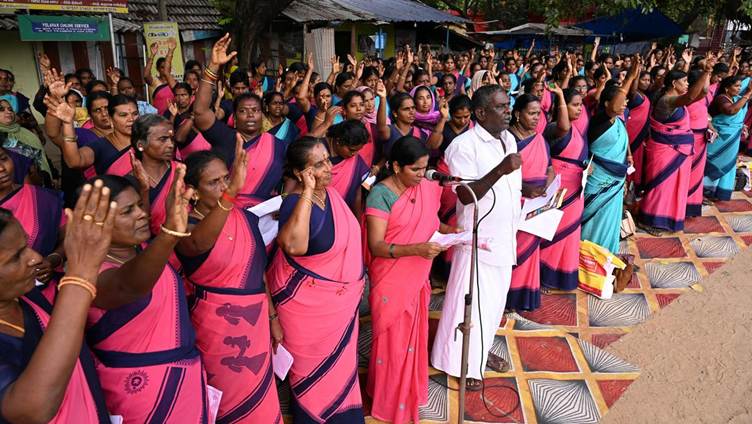
Source: The Hindu, 4th November, 2025
In a twist of fate, the conditions of its grassroots-level frontline care workers reek of negligence and spin a tale of carelessness towards its army of care workers. In West Bengal, Anganwadi workers participated in a rally under the aegis of the West Bengal Anganwadi Workers and Helpers Union and the All India United Trade Union Centre (AIUTUC) union of the Socialist Unity Centre of India (Communist), demanding an increase in the allocation of budget for these services, a hike in the remuneration, life insurance for workers dying during service, a pension on retirement, and disbursal of funds to purchase smartphones. Recently, in the light of the SIR drive, Anganwadi workers are overburdened with additional tasks without any compensation. In the neighbouring state of Jharkhand, the Jharkhand Pradesh Anganwadi Workers Union (JPAWU) Anganwadi sevikas and sahayikas marched, demanding an increase in honorarium for sevikas to 30,000 INR a month and 15,000 INR a month for sahayikas, as well as a pension of 50,000 INR upon retirement. Another of their grievances was being forced into retirement at 62 without receiving benefits. In Karnataka, the Karnataka State Anganwadi Workers Association, affiliated with Centre of Indian Trade Unions (CITU), is campaigning for an increase in the allocation in the budget, a hike in the honorarium to 26000 INR, entitlement to a fixed pension of 10000 INR, filling up vacant posts, and provision of better infrastructure and amenities. In Tamil Nadu, members of the Tamil Nadu Anganwadi Workers and Helpers Union—Centre of Indian Trade Unions (CITU) staged a protest to treat their occupation akin to government jobs, with a pension amount of 10,00,000 INR as the retirement benefit.
The recent spate of protests across these geographies led by the Anganwadi workers resonates with the agitations of the ASHA (Accredited Social Health Activist) that gained ground in the earlier half of the year and proved to be a significant turn in galvanizing attention to care work. These concatenations of protests gripping the country are a reminder that our frontline care workforce, composed of women, is still fighting for recognition as workers and basic amenities that could smooth their work. As per a recent report, although the Supreme Court of India has ruled in favour of Anganwadi workers and assistants under ICDS receiving gratuity, the Government of Karnataka has limited this benefit to those retiring from 2023 onwards. Anganwadi workers continue to languish from the apathy of the state and the society, and the alleged suicide attempt by a 59-year old elderly Anganwadi worker in Tamil Nadu is a testament to this.
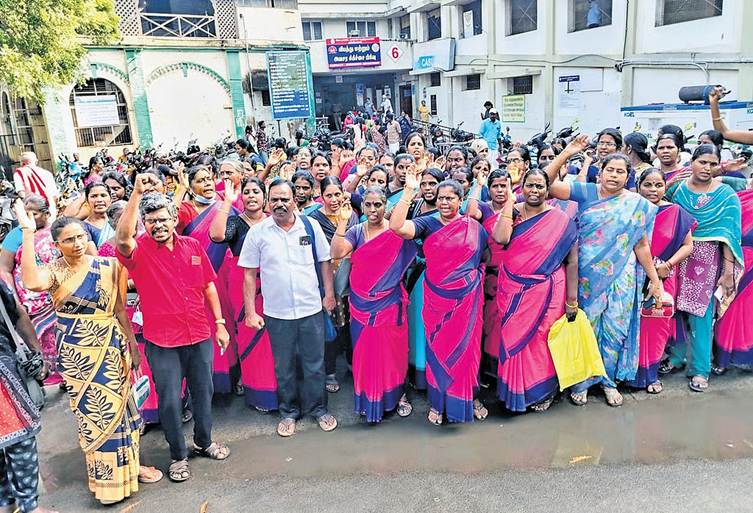
Source: The New Indian Express, 19th November, 2025
The challenges faced by Anganwadi workers are a stark reminder that, despite toiling and contributing to the healthcare ecosystem, they remain merely a ‘cog in the wheel’ and are expendable to the state. Much aligned to an extractive capitalist ethos, Anganwadi sevikas and sahayikas or the ASHA workers, are the marginalized class of women whose labour is treated as a resource, procured at a cheap rate, and dispensed as they reach old age, leaving them without employee benefits, recognition, or dignity. This peripheral position of careworkers shows that feminization of a workforce is not an indicator of empowerment; rather, it perpetuates the stereotype of women as care bearers, first responders, and ‘other-mothers,’ expected to devote themselves at the altar of community welfare without return or complaint. Another case in point of devaluing women’s labour is the much-contested IIT Kharagpur’s ‘campus mothers’ initiative that is pitched as a mother’s touch to heal distressed young adults and compensated through “token honorarium” and “out of pocket allowance”. In the guise of incorporating women in the community care ecosystem, the state and institutions continue to undermine women’s labour through tokenism and referring to these as voluntary.
These resistant struggles make a case for peak saturation that comes with shouldering the care of the community while the care workers languish. If we truly wish to honour our brethren of Anganwadi workers, ASHAs, domestic workers, cooks, and ayahs, or anyone else within the spectrum, it has to start with recognition of their labour as work, replacing the honorarium with a salary revised from time to time to keep up with the economy, taking stock of the occupational hazards and ensuring a safe environment, and providing a service-duration-based pension to support themselves and dependent family members.

 Sabr: A care collaborative
Leave a comment