
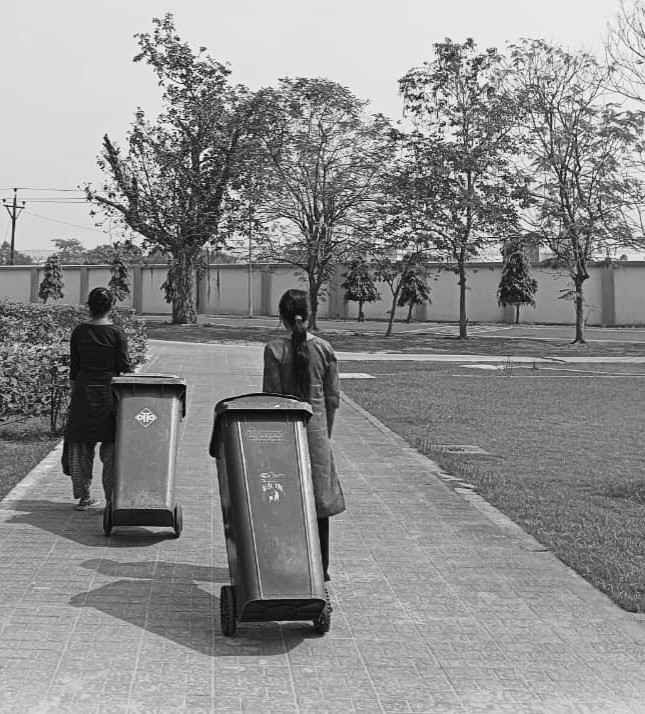
Kavitha: I wake up at 4:30 a.m. First, I complete all the household chores—cleaning the house and preparing meals for my son—after which I come here for work by 8. I leave this place around 4 p.m. It takes roughly an hour to reach home. I travel back and forth on foot. Once I am back, it’s time for me to attend to all the household chores (smiles). Later in the night, I spend some time with my son. Usually, we are up until 11 or 1 chatting.
Shalini: You sleep so late?
Kavitha: Yes, because that is the only time in the day I get to spend with my son. This is the only time when both of us are free.
Shaima: So, how much time do you get to sleep?
As much as I can manage, Kavitha responds (laughs).
This has been Kavitha’s routine for the past eight years. She lives with her son and works as a housekeeping staff at one of India’s elite educational institutions. Kavitha is a single parent and the primary caregiver at home. Her day at work begins with cleaning corridors, stairs, and common spaces of the hostel and emptying large dustbins. “This is the part of my job that I hate the most,” she says nonchalantly. There are two women employees at the hostel, and both seek help from other male co-workers to unload the garbage cans.
“The dustbins are too heavy for us women. To empty the bins, we have to coordinate with other male co-workers. I am doing this work out of necessity. These jobs are meant for men. Cleaning such massive corridors puts a lot of strain on my arms. Still, I have to do it.”
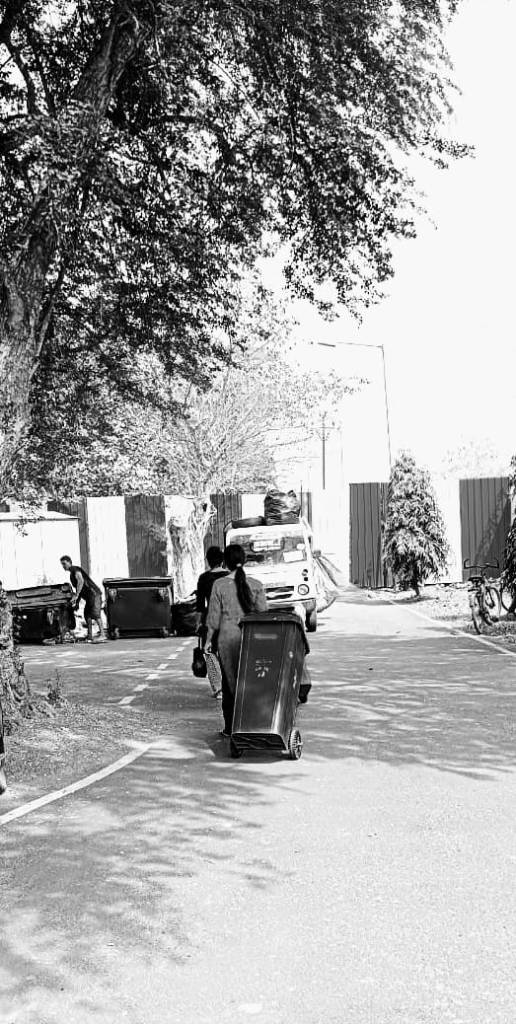
Kavitha affirms the received notions of what occupations are ‘better-suited’ for women. Even though an increasing number of women continue to work in construction sites, brick kiln communities, and agricultural fields, their labour (that consumes most of their lives) remains invisibilized. Before she started this job, Kavitha worked in the garden area at the institute premises. She was a homemaker, and only after her husband’s demise did she start working at the institute to support her family. She noted that even though her work entailed extensive cleaning, resulting in soiled clothes, they had no designated facilities like lockers, changing rooms, or a place to sit and have their meals. She narrated:
“Here, we do not have any room for ourselves, not even a place to sit and have our meals. There is a drinking water room which is currently not in use. So, we sit there to have our meals. Otherwise, we have to eat outside (in the hostel corridors). We do not even have uniforms here. Our work enatils cleaning. Our clothes get drenched while cleaning. We should at least get an almirah to keep our clothes or food. Where do I keep my food? If I keep it outside, the dogs will take it away.”
“I do not like this work,” says Kavitha. Unlike other occupations, their identity is often reduced to that of housekeeping staff, maid, or servant, even when their job might require a considerable degree of skill. Kavitha shared: “Sometimes, they call me ‘housekeeping!’ It doesn’t sound good, right? I have a name. Not everyone does that. But people say that sometimes.”
Amidst her tasks, Kavitha sometimes tends to ailing students, offering them care and support during times of distress. These are not part of her job description. Like her rest, Kavitha’s emotional labour, too is a threat to this system that sustains extraction. She mentioned how intimate interactions with students are discouraged since it takes their time away from work. She also felt burdened by additional tasks and responsibilities.
“Sometimes, when there are student parties, we are asked to clean the mess halls (student mess buildings are separate from the hostel building where Kavitha works). Sometimes, we are asked to clean the terraces. Our meal timings get affected. We leave late.”
Shalini: How do you manage?
“I somehow adjust (smiles).”
Kavitha and her co-workers do not receive any compensation for these additional tasks.
We asked Kavitha what she liked doing in her leisure time when she was ‘doing nothing.’
She likes to visit her parents on her off days. There’s hardly any time when thoughts from her familial, work or social setting are not playing on her mind. Kavitha manages the entire domestic sphere, from getting groceries and essentials to cooking meals and overseeing the repairs and maintenance work in the household. There’s hardly any time left for recreation. Working constantly has become her life’s rhythm, leaving little to no time for her to let loose, unwind, relax or pursue her passion.
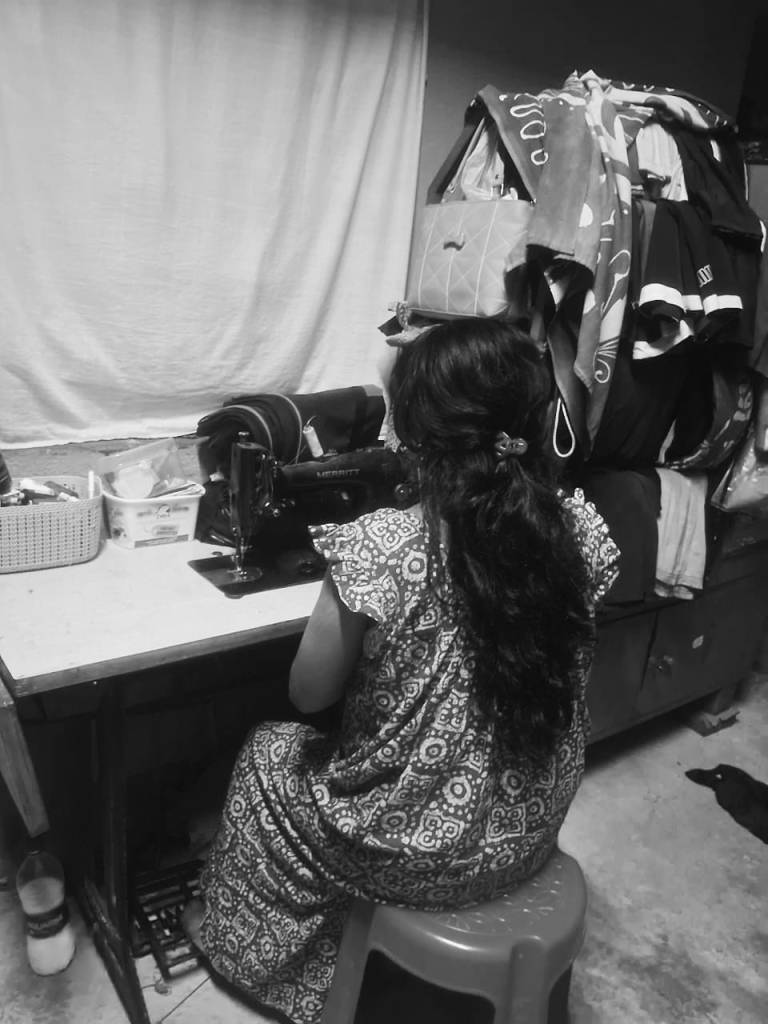
However, her eyes lit up when she shared her aspiration to start her tailoring venture someday. After returning home from work, Kavitha stitches and alters garments for students residing in the hostel. “The students here love my work,” she shared with immense pride and a wide smile. Even after working eight hours, Kavitha tries to find time for stitching fabrics. She takes orders in secrecy, fearing the administrative staff wouldn’t approve of it.
Kavitha spoke fondly of some supportive students and staff members at her place of work. During breaks between work, Kavitha loves chatting with students and her co-worker Shefali. They have meals together and share their tiffins with each other. Sometimes, they surprise each other by packing special lunches. Both single parents rely on their wages from this contractual employment to sustain their families. They confide in each other about their worries, aspirations, and feelings.
As much as co-workers would like to lean on each other for support at work (in the case of sickness or a family emergency), the overwhelming amount of work makes it difficult for them to fill in for someone else. They occasionally engage in some recreational activities. For instance, the hostel staff have an annual ritual of organizing a picnic where they cook meals together. Recently, the workers’ union at the institute organized a trip where all the staff members took a day off to visit a nearby town. Such co-worker relationships and workplace solidarities become essential in dealing with unfavourable work environments. For Kavitha, her leisure time with Shefali is her favourite part of the day at work.
Care workers employed within such elite educational spaces are not free from gender and caste biases. Kavitha shared a deeply personal anecdote where two senior staff members of the hostel passed indirect and derogatory remarks at her for collecting items that the students left behind after vacating their hostel rooms. She quoted the administrative staff:
Hum zamindar log hain. Hum ye sab nahi lete.
“We are Zamindars. We do not take what others leave behind.”
Kavitha shared that she has no shame in accepting things from students they no longer use or the items they leave behind. Her voice, though filled with anger, was also reflective. “What is the evil in doing that?” She asked. Some of these experiences expose the pervasiveness of caste in places of work—how it sustains social inequalities and corrodes human dignity.
Kavitha also shared a poignant moment of resistance. Kavitha and another female co-worker were being repeatedly harassed by a male staff who worked in the same institute. Though the institute has mechanisms for formal redressal of such complaints, neither was aware of the process to be followed. After putting up with it for several months, both women took up this issue with their co-workers, who discouraged them from filing a formal complaint. She shared:
“Everyone told us not to file a complaint. They said he (the accused) has his wife and children to look after. But we said no. He has done wrong (anyay). Whatever he had done was wrong. He [emphasis added] should have thought about his actions. He should have thought about his wife and his children. Why should we think? Nobody liked it. Still, we raised our voices. We went against everyone and fought. Everyone puts the blame on women. Hence, we were silent at the beginning. But then we thought it would be wrong to tolerate such behaviour.”
Although they faced hostility from their co-workers, they went ahead and lodged a complaint. Following their complaint, the accused was fired.
In this conversation, Kavitha took us through a day in her life, her routine, her family, her hardships to make ends meet, her labour and her aspirations. Kavitha’s narratives were replete with varied emotions. She didn’t like her job but carried immense pride in being able to support her family. She believes that she has learned and grown immensely ever since she started working. Today, she is a confident woman who smiles and laughs unapologetically. “Earlier, I was completely dependent on someone else. I was living within the four walls of my home. Now, I earn for myself. I make my own decisions,” says Kavitha.
She shared with us glimpses of moments filled with hope, strokes of resistance, a belief in an alternative imaginary to the taken-for-granted worldviews, and most importantly, an exercise of sabr in awaiting the day she gets to live her dream. Sabr in obtaining the privilege to take out some time for herself.
Mai kabhi ye socha nahi ki mai idhar yahan kaam karungi. Chalo majburi mein toh karna hoga na, mere bete ko palne ke liye. Jab beta mera bada ho jaye, uska koi job lag jaye, tab mai ye kaam shuru karungi. Mujhe tailoring ka kaam acha lagta hai.
“I never thought that I would have to do this work. But I had to do it out of necessity. To raise my son. I will start this work when he gets older and gets a job. I love the work of tailoring,” shared Kavitha.
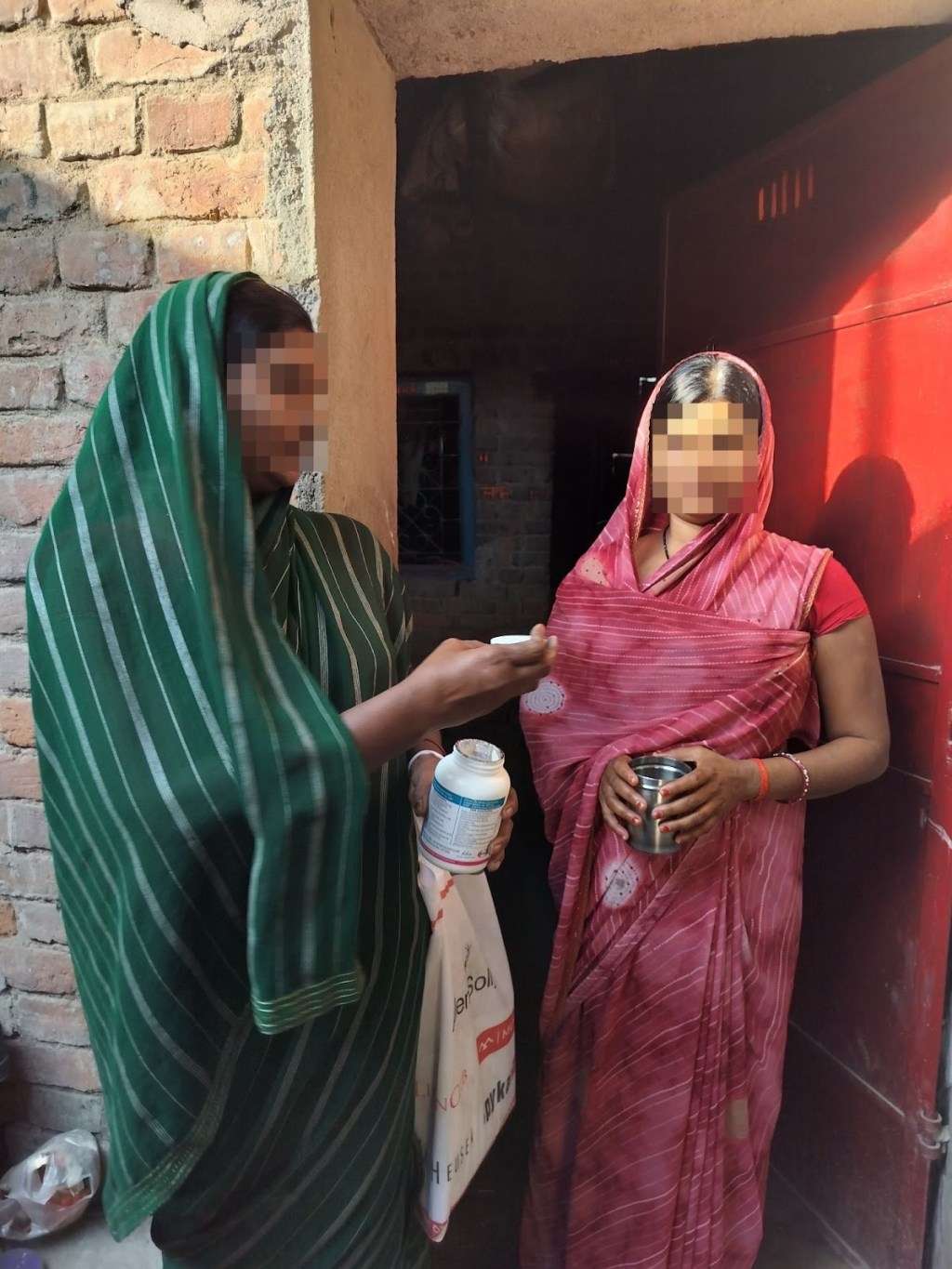
At Sabr, we bring stories, videos, text archives, photo essays, and reflections shared by individuals and communities engaged in care work. We invite you to take a peek into their everyday lives.
By Shalini and Shaima



 Sabr: A care collaborative
Leave a comment